
06:08
Carbide price volatility was one of the recurring themes in conversations at MACH 2026. Manufacturers, suppliers and cutting-tool specialists were all asking similar questions. Why are prices moving so quickly? How long could the uncertainty last? And what can engineering businesses do to reduce their exposure?
It was clear from our conversations at MACH that carbide pricing was occupying the thoughts of manufacturers across the sector. It was equally clear that cutting-tool companies such as Quickgrind were having the same discussions with customers, suppliers and industry partners.
For that reason, MTD Magazine will be unpacking the carbide challenge with Quickgrind from several perspectives.
We will begin by examining the economic, geopolitical and industrial forces affecting carbide prices. We will discuss how manufacturers can reduce the operational impact of higher tooling costs, extend the productive life of their tools, and ultimately recover value from carbide through a more circular approach.
Here, Quickgrind Managing Director Ross Howell and Sales Director Brian Pearce discuss why carbide prices are under pressure and what manufacturers might expect over the next 6, 12 and 18 months.
A question bigger than cutting tools
For many engineering businesses, the recent movement in carbide prices has felt sudden. Quotations are changing more frequently, periods of price validity are becoming shorter, and purchasing teams are facing difficult conversations about tooling budgets.
However, the price of a carbide tool is influenced by far more than the cost of grinding and coating the finished product.
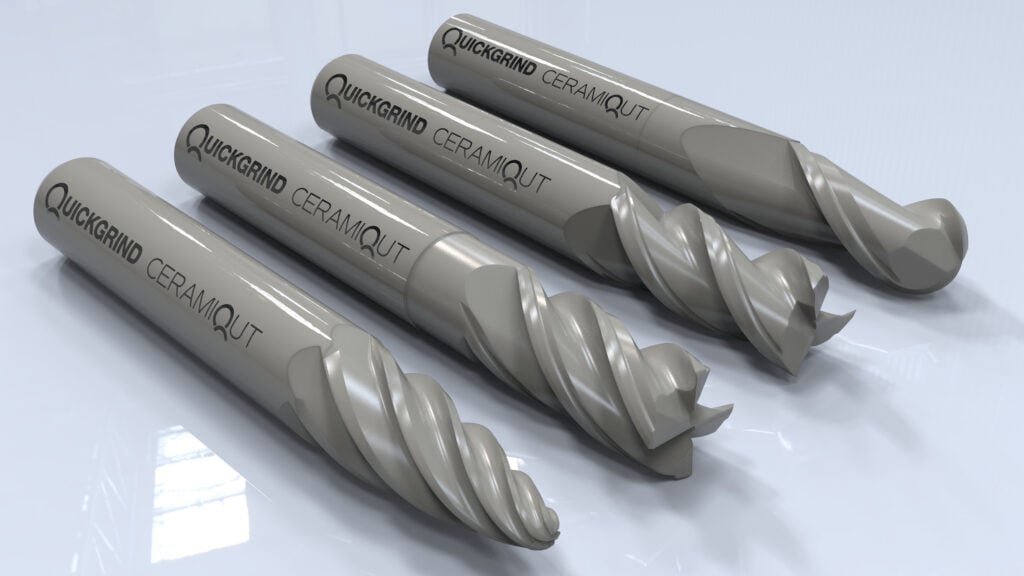
The process begins with the extraction of tungsten ore. It then passes through concentration, chemical conversion, powder production, carbide grade formulation, pressing and sintering before a usable carbide rod or blank is produced. Only then can the cutting tool itself be manufactured.
Cobalt, most commonly used as the metallic binder within cemented carbide, introduces another international raw-material market into the equation.
A disruption near the beginning of either supply chain can therefore influence every stage that follows. Ross Howell says the scale of the issue is not always immediately visible to the end user. “Manufacturers understandably see the finished cutting tool and the price attached to it. What they do not always see is the complex global supply chain behind that tool. By the time a carbide blank reaches us, the material has already passed through multiple processing stages, each with its own energy, labour, transport and availability pressures.”
Concentrated production
Tungsten is found in a number of countries, but present-day commercial production remains heavily concentrated.
US Geological Survey estimates indicate that China produced approximately 67,000 tonnes of tungsten in 2025, from estimated worldwide production of around 85,000 tonnes. This equates to almost four-fifths of global mine output.
Cobalt production is concentrated differently, but it presents a similar supply-chain issue. The Democratic Republic of Congo accounted for an estimated 73% of mined cobalt production in 2025, while a significant proportion of refining capacity is in China.
This concentration does not necessarily mean that the material will become unavailable. It does mean that policy changes, production restrictions, logistics problems or increased domestic demand within a major producing country can have an outsized influence on international supply.
New sources cannot be switched on rapidly. A mineral deposit must be assessed, financed, permitted and developed. Processing and refining capacity must also be available before the material becomes useful to cutting-tool manufacturers.
The gap between identifying a resource and producing consistent commercial material can be measured in years rather than months.
Export controls and reduced visibility
In February 2025, China introduced export controls covering selected tungsten-related products. These controls did not amount to a complete ban, but they created additional licensing requirements and gave the authorities greater oversight of relevant exports.
The market response was significant. During 2025, reported prices for tungsten concentrate and ammonium paratungstate, commonly known as APT, increased sharply.
The direct price movement was only part of the impact. Export controls also introduced uncertainty around lead times, available volumes and the speed at which international buyers could secure replacement material.
Brian Pearce says that this reduced visibility is one of the biggest concerns for customers. “The conversations we are having are not simply about whether the price has increased. Customers want to know whether it will increase again, how long a quotation can be held and whether the tool they need will still be available when the next production order arrives.”
That uncertainty makes budgeting difficult, particularly for subcontract manufacturers quoting work months in advance.
Competing demand
The cutting-tool industry is also competing for tungsten and cobalt with other strategically important sectors. Tungsten is used in aerospace, defence, electronics, energy, wear-resistant components and a range of high-temperature applications. Its hardness, density and heat resistance make it difficult to substitute without compromising performance.
Cobalt is used in batteries, superalloys, catalysts and magnets, as well as in cemented carbide.
Demand from these industries can remain strong even when parts of the general manufacturing market are subdued. This helps explain why carbide prices do not always follow the same pattern as machine-tool investment or subcontracting activity.
Alternative cutting materials have an important role, and ceramics, cermets, high-speed steels and other grades may be appropriate in specific applications. None, however, provides a universal substitute for tungsten carbide. For many machining processes, carbide still offers the necessary combination of productivity, tool life, accuracy and process security.
More than a raw-material calculation
Published tungsten and cobalt prices are useful indicators, but they do not translate directly into the final price of a cutting tool. Blank manufacture requires energy and specialist processing. Tool production adds precision grinding, skilled labour, inspection, edge preparation and coating. Freight, stockholding and finance costs must also be considered.
Currency movement can further amplify these pressures. Raw materials and internationally traded products are often priced in US dollars, so changes in the value of sterling can influence the cost paid by UK suppliers. Stock positions create another complication. One supplier may still be working through material purchased before a major increase, while another may already be buying replacement stock at the new market price.
This can result in sudden adjustments rather than a steady increase across every supplier at the same time.
What happens next?
No manufacturer can predict commodity pricing with certainty, particularly when trade policy and geopolitical decisions are involved. Quickgrind’s outlook is therefore based on market conditions rather than a guaranteed price forecast.
The next six months
In the short term, carbide prices are likely to remain elevated and sensitive to further developments. Export licensing, restricted supply and strong strategic demand are unlikely to disappear immediately. Quotation periods may remain shorter, particularly for products requiring large quantities of carbide or less common blank dimensions.
The next twelve months
Over the following year, the market may become more predictable as suppliers adapt their purchasing strategies and licensing processes become better understood. Greater predictability should not be confused with a return to previous price levels. Stabilisation may occur at a higher underlying cost.
Manufacturers are also likely to see increased interest in stock management, alternative sourcing, recycled carbide and more selective use of solid-carbide construction.
The next eighteen months
Over a longer period, investment in mining and processing outside the established supply centres may begin to improve resilience. Major new capacity, however, will take time to influence the market. The more immediate change is likely to be how manufacturers manage carbide within their own operations.
How much carbide does a tool contain? Is solid construction necessary? Is the tool being used at its most productive? Can it be remanufactured? What happens when it reaches the end of its usable life?
These questions will become increasingly important if carbide remains a high-value and strategically sensitive material.
From price per tool to value per component
The instinctive response to higher tooling prices may be to find a cheaper alternative. In some cases, that will produce a genuine saving. In others, it may simply transfer cost elsewhere in the process. A lower-priced tool that produces fewer parts, requires more frequent changes or increases cycle time may ultimately cost more.
For this reason, manufacturers may need to move the discussion away from purchase price and towards cost per completed component.
Howell believes this broader view will become essential. “We cannot control global tungsten production or international trade policy. What manufacturers can control is how effectively the carbide entering their business is used. The objective should be to gain the greatest possible productive value from it.”
That means applying the correct tool, geometry, cutting data and machining strategy. It may also mean using modular construction, remanufacturing a tool several times, or recovering its residual material value when it can no longer be returned to production.
Carbide pricing may be shaped by global forces, but carbide consumption is still influenced on the shop floor.
In the September issue of MTD, we will ask Quickgrind how manufacturers can reduce the operational impact of higher carbide costs, and why cost per component may be a more useful measure than cost per tool.