
🎧ModX Orbis delivers finish, reach and cost savings in automotive engine manufacture
🎧ModX Orbis delivers finish, reach and cost savings in automotive engine manufacture
0:00 / 0:00
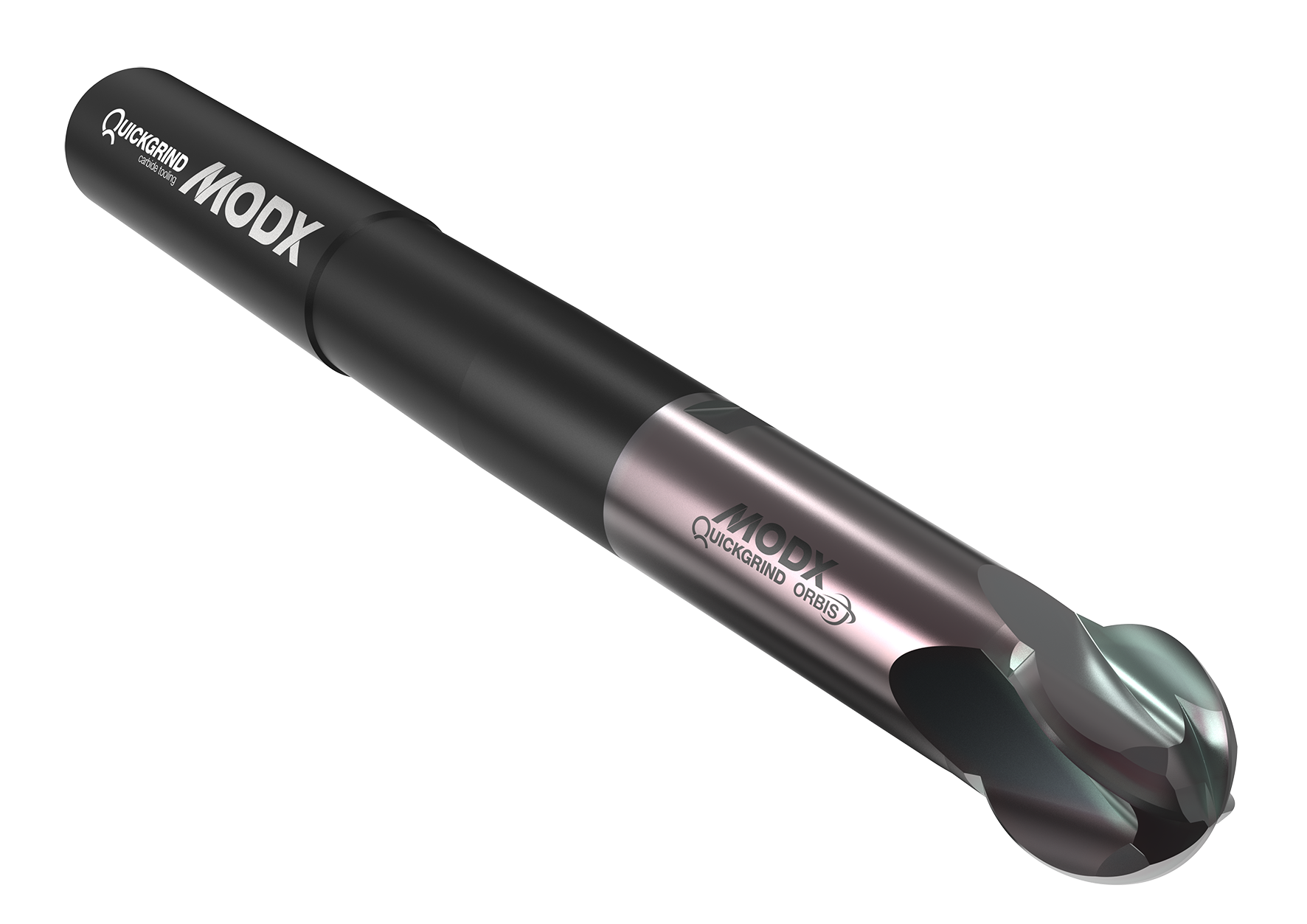
When a race engine manufacturer needed to enhance port finishing in a demanding 5-axis application, Quickgrind developed a customised Orbis lollipop solution that solved the machining challenge, it also evolved into a more cost-effective ModX alternative.
The manufacturer’s problem was worsened by the indexable tools then in use, which limited both access and finish quality. After discussions with the client, Quickgrind’s QuickCam service identified the Orbis lollipop range in solid carbide as the most suitable solution.
Using QuickLab, Quickgrind’s tool design facility, the tools were specifically designed and simulated to ensure the correct overall length and tapered neck geometry for trouble-free machining with 5-axis tool paths. For this application, the 16mm diameter tools needed to be 140mm long, with an 85mm tapered neck.
Once approved, test tools were ordered and trialled. The tools performed extremely well, delivering the required surface finish. Tool life testing proved equally successful, leading to the supply of production tools that have continued to run for many years.
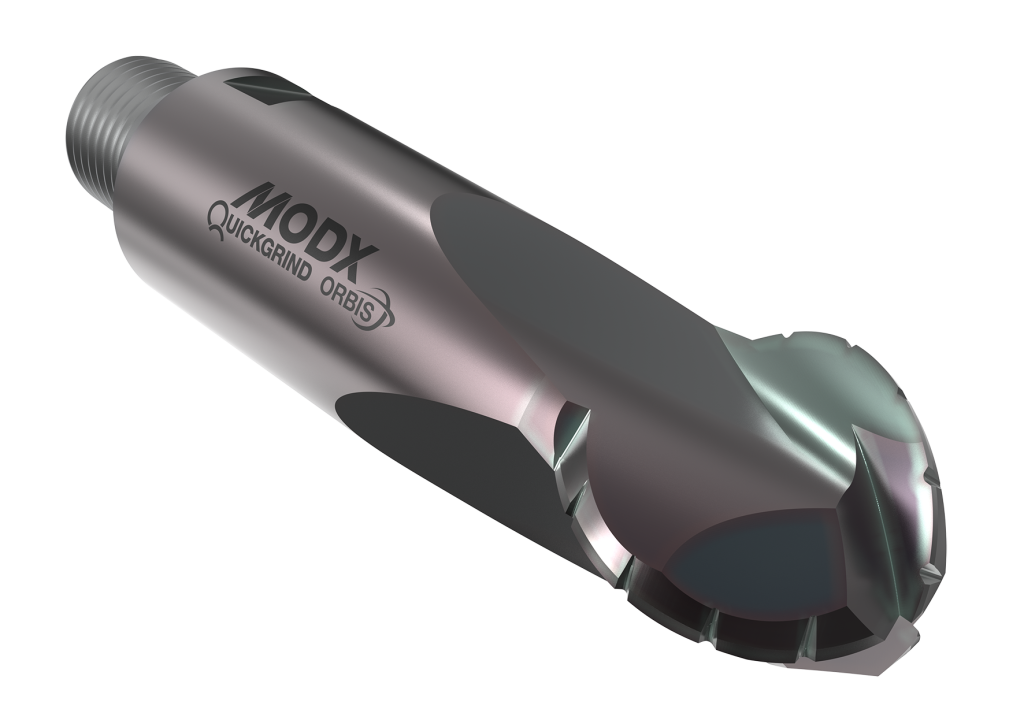
As Quickgrind’s tool development progressed, the introduction of the ModX interchangeable head range created a further opportunity. Because of the long overall length required by the original solid carbide design, the ModX modular system was proposed as a more cost-effective alternative.
The client was keen to explore the new concept. QuickLab once again went to work, developing a tool based on the proven Orbis geometry but adapted to the ModX platform. To suit the reach and clearance demands of 5-axis machining, the ModX shank was also modified.
Working closely with the client’s engineering team, trial tools were ordered and supplied for approval. Within weeks, the new solution had demonstrated the same proven performance as the original solid tools, while bringing the added advantage that only the heads needed to be reordered. The result was a worthwhile reduction in tooling costs, alongside the environmental benefit of a more resource-efficient system. It also reduced carbide consumption, an increasingly valuable advantage at a time of continued volatility in tungsten carbide prices.
What are lollipop tools?
Lollipop tools are cutting tools with a spherical head on a narrow neck and large shank, named for their shape. This design enables them to access recessed areas, undercuts, and complex internal forms that standard ball nose or flat end mills struggle to machine without shank interference.
The cutting portion is usually made from solid carbide for rigidity and wear resistance, suitable for demanding applications like machining aluminium alloys in racing cylinder heads. These tools excel in CNC machining centers, especially 5-axis machines, enabling precise control of tool orientation for complex internal port geometry.
Ports in aluminium race engine heads
In racing engines, airflow efficiency greatly affects power. The design of intake and exhaust ports in aluminium cylinder heads determines how well air, fuel, and exhaust gases flow. Lollipop tools or spherical undercut end mills are useful for creating complex internal geometries that standard cutters can’t easily shape.
During intake and exhaust port machining, the goal is to replicate a carefully designed aerodynamic profile, often developed from computational fluid dynamics analysis or extensive flow-bench testing. While traditional end mills can shape much of the port form, certain areas, particularly around valve seats, short-side radii, and deep undercuts, are much harder to access.
Their narrow neck enables the cutting head to enter the port while keeping the shank clear of surrounding surfaces. Simultaneously, the spherical cutter can machine concave and undercut shapes while maintaining a consistent engagement angle. This allows the production of complex, high-performance forms that would otherwise demand extensive manual finishing.
Surface finish andflow performance
The surface finish inside intake and exhaust ports directly affects airflow behaviour. A highly polished surface is not always the best choice. In many intake ports, a lightly textured finish can help maintain fuel atomisation, while exhaust ports often benefit from smoother surfaces to reduce resistance and minimise heat build-up.
Lollipop tools aid in achieving these target finishes by enabling consistent CNC-machined surfaces instead of relying solely on hand porting. Used with fine step-overs, the spherical cutter creates a smooth scalloped pattern that can be refined further if needed.