04:40
🎧Studer’s strategic response to global market turbulence
Last month in Steffisburg, Fritz Studer AG opened its doors for its annual press conference. Amid geopolitical uncertainties and challenging market conditions, the 114-year-old manufacturer of precision cylindrical grinding machines presented a compelling story of resilience, innovation, and strategic growth. By Rhys Williams
Under the motto ‘Swiss Made’, the event brought together CEO Sandro Bottazzo, Chief Technology Officer Daniel Huber, and Chief Operating Officer Stephan Stoll to deliver what proved to be a comprehensive overview of the company’s performance and future direction.
Exceeding Expectations in Turbulent Times
Opening proceedings, Sandro Bottazzo set the tone with a frank assessment of the market. “2025 was marked by challenging markets and geopolitical uncertainties. Nevertheless, we exceeded expectations and emerged from this phase stronger than ever.”
Although total sales were slightly below the previous year’s figure, a strong performance towards the year’s end meant the company surpassed its own expectations. More notably, Studer exceeded last year’s level in terms of machine orders received, with a particularly encouraging 44% of new customers.
The geographical breakdown revealed both challenges and opportunities. Studer achieved impressive sales in North America despite customs challenges – a diplomatic reference to the trade tensions that have complicated transatlantic business. Asia delivered results above the previous year’s level, with China proving especially strong. European performance was mixed, with France, the Czech Republic and Denmark exceeding expectations, whilst traditional strongholds like Germany, Italy, and Switzerland fell short.
Critical was maintaining or expanding market share in all regions worldwide. “Our broad portfolio remains a pillar of success and covers a wide range of universal cylindrical grinding applications,” Bottazzo emphasised.
Aerospace Soars to New Heights
One of the most striking revelations was Studer’s performance in the aerospace sector, which delivered another record year. The aerospace segment closed as the largest single segment for the first time, accounting for almost a third of all orders. This milestone represents a significant shift in the company’s customer base.
Other important categories included precision engineering, machine tools and the automotive industry, demonstrating the breadth of Studer’s market penetration. Among the product lineup, the S33 emerged as the best-selling machine, followed by the S31 and S41. Both external and internal cylindrical grinding machines performed well.
The customer care segment delivered particularly impressive results. “Thanks to our global, customer-focused service organisation, we were able to set new sales records in the service and maintenance business areas,” Bottazzo explained. In many markets, over 70% of the active installed base now has a maintenance contract – an achievement that ensures recurring revenue and deepens customer relationships.
Technological Innovation Takes Centre Stage
Following Bottazzo’s business overview, Daniel Huber presented Studer’s latest technological developments. The CTO’s presentation centred on two major product launches from 2025 that are shaping the company’s future: the S23 universal cylindrical grinding machine and the latest generation of favoritCNC.
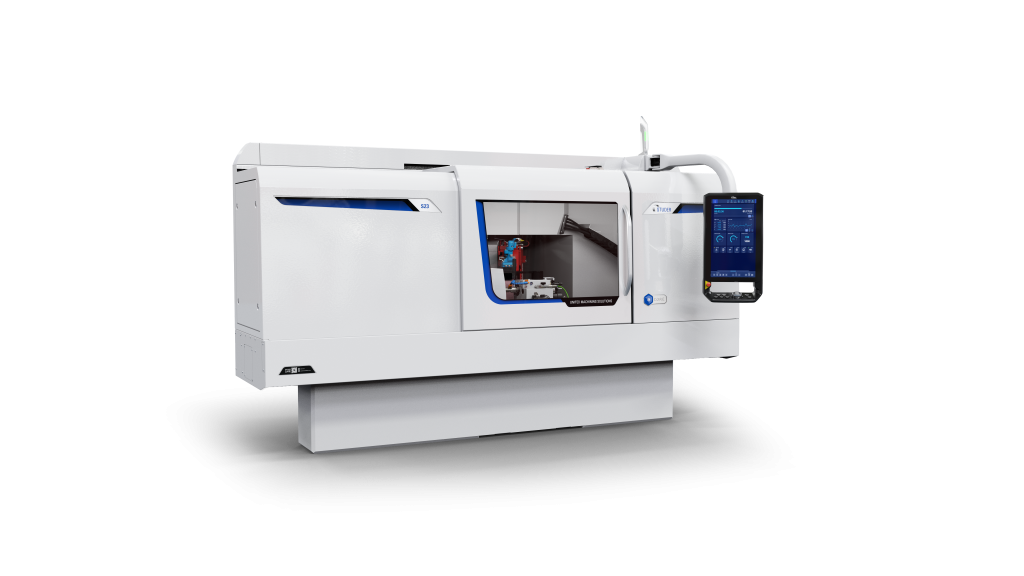
The S23, unveiled at EMO in Hanover in September 2025, represents Studer’s strategic move to strengthen its position in the entry-level and premium segments. “Thanks to its high-quality features, precision and flexibility, the S23 complements our portfolio in the entry-level and premium segments,” Huber explained, echoing Bottazzo’s earlier comments.
With a compact footprint yet state-of-the-art grinding technology, the S23 incorporates the modern C.O.R.E. hardware and software architecture, an automatic B-axis with 1° Hirth coupling for up to three grinding tools, frequency-controlled motor spindles or belt drives, and crucially, a machine base made of Studer’s proprietary Granitan material.
The innovative wheelhead design allows great versatility for grinding tools in a single clamping, increasing efficiency, particularly with geometrically complex workpieces. The distance between centres measures 650mm or 1m with a centre height of 175mm, whilst state-of-the-art features include contact detection, semi-automatic balancing of the external grinding wheel and an optional in-process measuring system.
Automation capabilities were also highlighted, with standardised loader interfaces for easyLoad and insertLoad enabling efficient and economical production automation. “This makes the S23 a high-precision universal cylindrical grinding machine with an excellent price-performance ratio,” Huber summarised.
The favoritCNC also garnered attention, with its modern FANUC control and automation features receiving a very positive market response. Huber also discussed significant advancements, including the further development of WireDress for internal cylindrical grinding, which allows contact-free dressing of metal-bonded grinding wheels within the machine.
Customers also benefit from a new axis system for the S31 and S33 models, which allows automatic adjustment to different workpiece lengths. On the digital front, Huber announced that C.O.R.E. Release 5.0, which enables access to Transaction Network’s manufacturer-independent customer portal directly from the machine operating panel.
Market Demand and Regulatory Challenges
Huber highlighted two major industry themes that resonated throughout the event: automation and regulatory compliance. Market demand for automation continues to rise to address skilled labour shortages and boost productivity. Studer’s response with the S23’s standardised automation interfaces and the S100’s features positions the company well for this trend.
However, a significant challenge looms on the horizon. Huber discussed the Cyber Resilience Act, due to come into force in 2027, which will impose new security requirements. “We are preparing comprehensively for these requirements,” Huber assured attendees.
Operational Excellence Drives Efficiency
Stephan Stoll, Chief Operating Officer, then took the stage to discuss operations, automation, modernisation and logistics – the often-overlooked foundations of manufacturing excellence.
“In 2025, we took our production and logistics processes to a new level,” Stoll explained. The centrepiece was the creation of a small parts warehouse that represents a quantum leap in Studer’s operational efficiency. This fully automated system employs 32 autonomous robots managing 16,000 containers, offering space for tens of thousands of parts. The warehouse significantly increases efficiency for both machine and spare parts logistics whilst forming a foundation for future growth.
Fifty Years of Granitan
The conversation then moved to a celebration of innovation with deep historical roots. 2025 marked the 50th anniversary of Granitan, Studer’s proprietary machine base material that has been fundamental to the company’s reputation.
The revolutionary mineral casting material was developed when Studer’s engineering team, working with partner organisations, identified epoxy resin as a two-component binder that is stable in the long term and doesn’t absorb water, unlike the cement-based concretes other manufacturers had experimented with. The result, christened Granitan, could be shaped at room temperature and moulded quickly and efficiently in-house.
Granitan’s damping behaviour is approximately 15 times better than gray cast iron, with vibrations quickly absorbed by the contact surfaces between rock grains and the binder matrix. The thermal properties are equally impressive: compared to gray cast iron, Granitan can absorb twice as much heat energy before temperature changes by one degree Celsius, whilst heat transfers up to 13 times more slowly in the machine base.
Today’s Granitan is the result of continuous optimisation, and research. Since 2009, Studer has manufactured its Granitan machine bases through a joint venture with Schneeberger in a highly specialised production facility in Cheb, Czech Republic.
One exciting prospect for the future is the potential integration of sensor technology and electronics directly into the machine base, made possible by the cold casting process. “Granitan is more than just a material; it is a technology kit and a platform for future innovations,” conference attendees were told.
Investing in the Next Generation
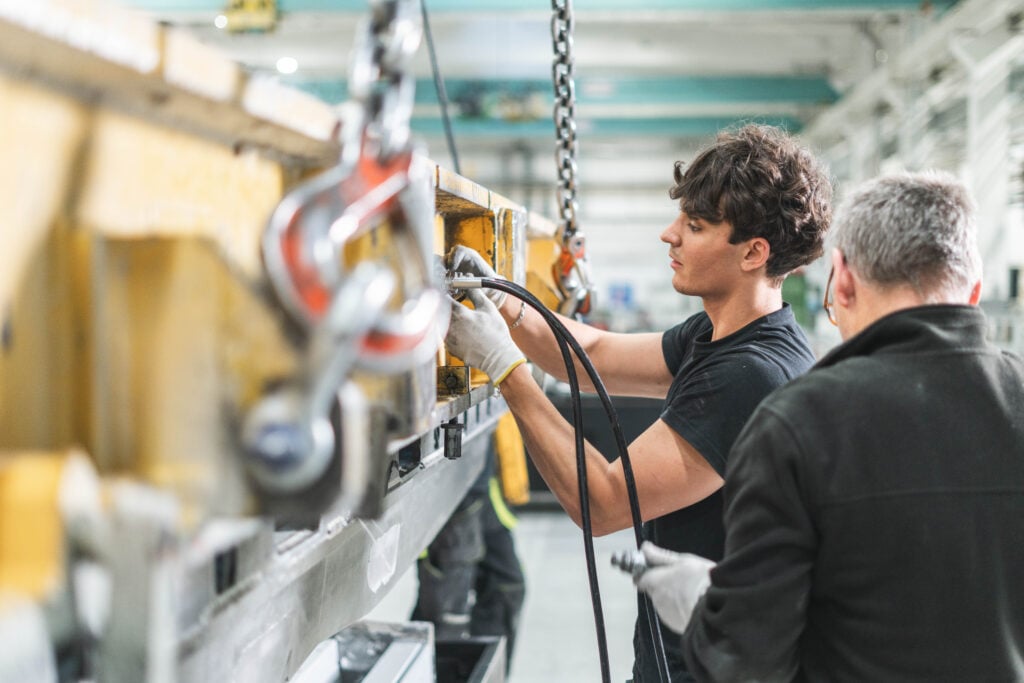
The final major theme of the press conference was Studer’s commitment to dual vocational training, which accounts for approximately 10% of the workforce. This investment in apprenticeships is not merely altruistic – it’s a strategic imperative that ensures Studer has the skilled workforce necessary to maintain its competitive edge.
Studer currently offers eight Federal Certificate of Proficiency (EFZ) apprenticeships: automation engineer, automation technician, commercial clerk, design engineer, logistics specialist, mediamatician, polymechanic and production mechanic. The four-year programmes combine practical work at Studer with theoretical instruction at vocational school and inter-company courses.
The company’s commitment is evident in its infrastructure: five full-time and four part-time vocational trainers, plus over 50 specialist trainers across departments, supervise the apprentices. The quality of Studer’s training is regularly validated at SwissSkills, EuroSkills and WorldSkills competitions. In recent years, Studer apprentices have repeatedly won gold, silver and bronze medals, demonstrating that the company’s dual training ranks amongst the best in the world.
Looking Ahead: Growth and Optimism
CEO Bottazzo concluded the press conference with a forward-looking perspective. In the third and especially fourth quarters, Studer recorded a significant increase in machines sold, a trend expected to continue into 2026. “Demand for high-quality grinding machines will continue to recover, and the response to our new S23 has been very good. The first machines have already been successfully sold and delivered,” he stated.
The company expects further growth in the current fiscal year, supported by strategic investments in innovation, infrastructure and workforce development. An additional development in 2025 was the acquisition of GF Machining Solutions by the United Grinding Group, which now operates as United Machining Solutions. With total sales exceeding USD$1.5bn and around 5,000 employees at over 50 locations, the group is one of the largest machine tool manufacturers globally. As part of this acquisition, the Studer Competence Centre for internal cylindrical grinding relocated to modern United Machining premises at Roger-Federer-Allee 7 in Biel, Switzerland.
Opt in today to our newsletter
Your partner for marketing, media, and events in manufacturing.