

Why EDM Automation Is Critical to Keeping Europe’s Aerospace Industry on Track
Europe’s aerospace industry is booming, but factory floors are struggling to keep pace. Order books are full, yet bottlenecks in precision component manufacturing threaten to delay deliveries and drive up costs. The issue is not demand — demand remains strong — but under-utilisation, labour shortages and inefficient workflows are constraining output.
Hakan Aydogdu, CEO of Tezmaksan Robot Technologies, believes automation offers a clear path forward. “Automating electrical discharge machining EDM systems provides a realistic way to unlock latent capacity, reduce lead times and strengthen Europe’s aerospace supply base,” he said.
EDM plays a vital role in manufacturing some of the sector’s most demanding components, including turbine blades and fuel injectors. Unlike conventional machining, which removes material mechanically using rotating tools, EDM uses controlled electrical sparks between an electrode and a workpiece submerged in dielectric fluid. This process allows extremely hard metals to be machined into complex geometries with micrometre-level accuracy, without introducing the mechanical stresses associated with traditional cutting methods.

Despite its advantages, EDM is often slow, operator-intensive and difficult to scale. While it is not the only bottleneck in aerospace manufacturing, it is one of the clearest opportunities where automation could unlock significant additional capacity. To remain globally competitive, Europe’s EDM operations must become lights-out, traceable and repeatable.
Market pressures are intensifying. According to the Aerospace and Defence Industries Association of Europe, the sector generated 290.4 billion euros in turnover in 2023, supporting 1.03 million jobs and sustaining growth of more than 10 percent year on year. Production, however, continues to lag behind demand. Germany’s aerospace revenues rose to 52 billion euros in 2024, a 13 percent increase, with civil aviation alone contributing 39 billion euros, up 18 percent. The UK is facing record backlogs in commercial aircraft and engine programmes, while Spain’s aerospace turnover exceeded 12 billion euros in 2024.
Even modest improvements in EDM utilisation — such as moving from single-shift to multi-shift operations or enabling weekend and night-time production — could dramatically increase output without the need for additional machines or factory space. However, automation requires investment, robust infrastructure and compliance with strict aerospace certification standards, all of which can be challenging for small and medium-sized suppliers.

EDM remains strategically irreplaceable because it enables processes that no other technology can reliably achieve. Modern hot-section components, such as turbine blades and vanes, are manufactured from nickel-based superalloys and require thousands of precision cooling holes and complex internal features. These cannot be produced consistently by milling or drilling without risking thermal damage, tool wear or dimensional inaccuracies. EDM, particularly fast-hole drilling, can produce holes as small as 0.3 millimetres with aspect ratios exceeding 150 to one, while preserving material integrity. When combined with laser machining for roughing, EDM delivers final dimensional accuracy within microns.
Spain’s aerospace sector illustrates the opportunity. Many suppliers still operate EDM processes on a single shift with significant manual intervention. Introducing automated EDM cells would allow round-the-clock operation, significantly increasing output without expanding headcount. Germany faces similar pressures, with companies such as MTU Aero Engines already operating what it describes as almost fully automatic turbine blade systems. In the UK, Rolls-Royce, Airbus UK and their Tier One and Tier Two suppliers are all contending with unprecedented engine backlogs.
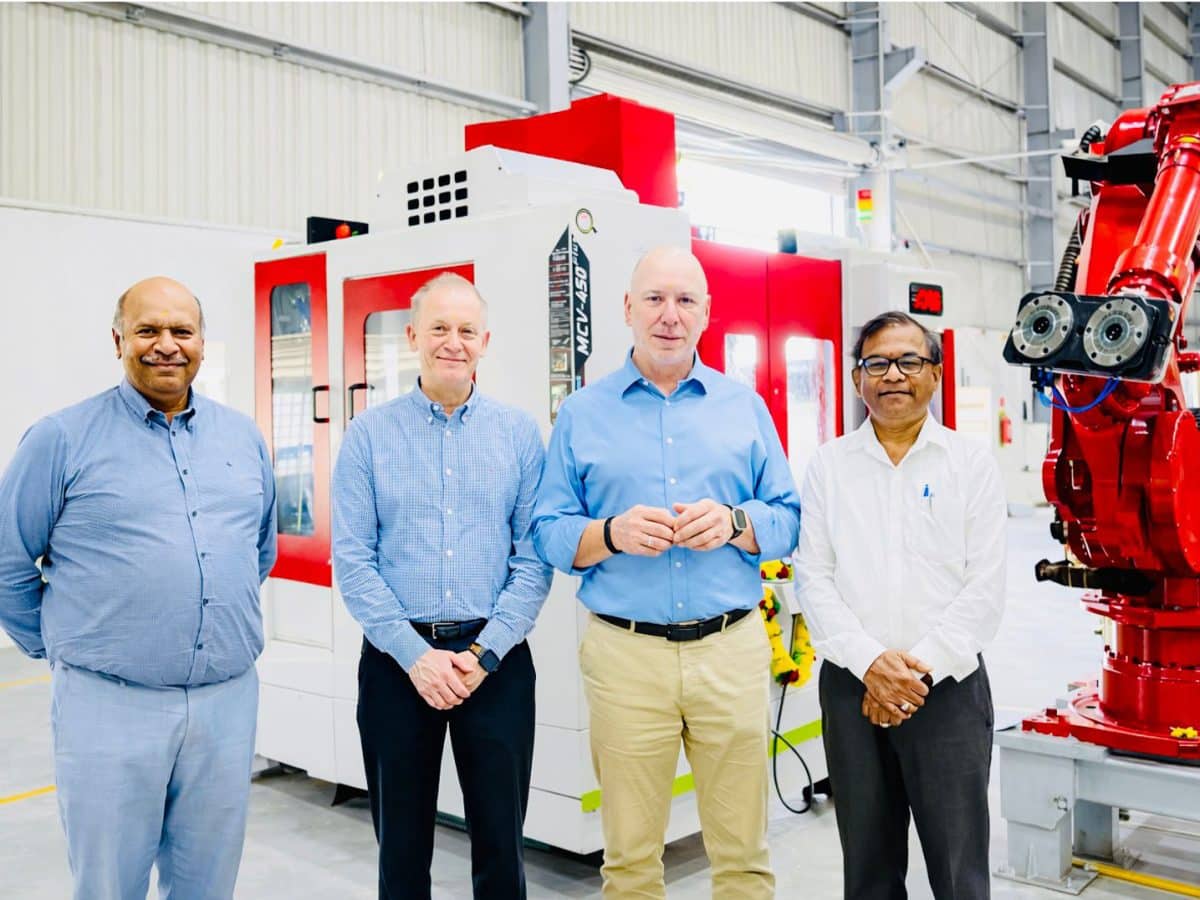
One practical example of EDM automation is the EDMCell CUBE, a fully integrated system that transforms a conventional EDM machine into a continuous, high-productivity manufacturing cell. The solution combines a Mitsubishi MV1200R Connect wire-cut EDM machine, a Mitsubishi MELFA RV20FRM six-axis industrial robot and a CubeBOX Pallet Pool, all coordinated by RoboCAM management software. Raw components are stored within the pallet pool, automatically loaded into the machine by the robot and removed as finished parts without human intervention. RoboCAM manages job scheduling, program allocation and full production traceability.
By enabling lights-out operation, systems such as the EDMCell CUBE extend machine uptime into nights and weekends, effectively adding additional shifts without increasing labour. Automation stabilises quality through consistent handling and fixturing, while reducing lead times by eliminating setup delays and idle changeovers.
As Mr Aydogdu concludes, Europe already has the orders, technology and expertise required to succeed. What it lacks is sufficient machine time. EDM will remain critical to aerospace manufacturing, particularly for hot-section engine components that directly affect fuel efficiency and performance. But as long as EDM remains manual, slow and intermittent, it will continue to act as a bottleneck. For Europe to maintain its competitive edge in aerospace, embracing EDM automation is no longer optional — it is essential.