Hainbuch Maxxos T-212 Mandrel Enhances Machining Stability Through Advanced Clamping Geometry!
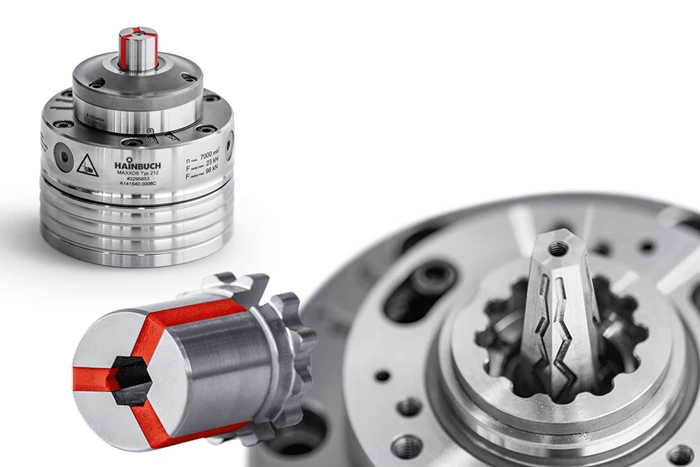
Hainbuch has expanded its Maxxos family of mandrels with the introduction of the Maxxos T-212, an advanced ID clamping solution designed to deliver greater rigidity, stability, and machining performance. The system introduces a unique hexagonal pyramid clamping interface that replaces the traditional round connection between the mandrel body and the segmented clamping bushing, fundamentally improving torque transmission and vibration resistance.
Unlike conventional mandrels that rely primarily on friction for holding force, the Maxxos T-212 uses a positive mechanical fit created by its hexagonal geometry. This design distributes forces across six contact surfaces, creating a much more rigid connection between the clamping bushing and mandrel body. The result is significantly reduced micro-movement during machining, improved damping characteristics, and enhanced overall process stability.
This increased rigidity allows manufacturers to run more aggressive machining parameters with greater confidence. Shops can increase feed rates, take heavier cuts, and maintain higher consistency in part quality while also extending cutting tool life. The improved stability is particularly valuable in demanding machining environments where vibration and deflection can negatively impact accuracy and surface finish.
The Maxxos T-212 is engineered to behave less like a conventional mandrel and more like a structural extension of the spindle itself. This characteristic helps improve machining precision during high-performance operations, especially when working with complex or high-value components requiring tight tolerances.
Another key feature of the system is its draw-bolt-free design. Traditional mandrels often require draw bolts extending into the workpiece, limiting usable clamping length and complicating machining for certain part geometries. By eliminating the draw bolt, the Maxxos T-212 enables full utilisation of the clamping length, making it particularly suitable for components with blind bores or minimal clamping surfaces.
The system also incorporates an integrated pull-back effect that securely positions the workpiece against the end stop. This improves axial stability and ensures highly repeatable positioning throughout complex machining cycles, contributing to greater process reliability and precision.
In terms of accuracy, the Maxxos platform delivers standard runout accuracy of ≤0.01 mm, with higher-precision options available down to ≤0.002 mm. These capabilities make the system suitable for high-precision manufacturing sectors where dimensional consistency and surface quality are critical.
Overall, the Maxxos T-212 reflects the growing emphasis on advanced workholding solutions in modern manufacturing. By combining innovative geometry with precision clamping technology, Hainbuch has developed a system that enhances machining stability, supports higher productivity, and enables manufacturers to achieve more reliable and efficient high-performance machining operations.