CNPC Powder and Brose Drive Closed-Loop Additive Manufacturing Using Recycled Steel!
CNPC Powder, a Vancouver-based specialist in advanced metal powders, has entered into a strategic partnership with global automotive systems supplier Brose to advance sustainable, circular manufacturing in the automotive sector. Under this collaboration, steel scrap generated from Brose’s production lines in China will be recycled and converted into high-quality iron-based powders for Additive Manufacturing (AM), establishing a closed-loop material cycle that links production waste directly back into manufacturing.
The partnership reflects a growing shift within industrial manufacturing toward circular economy principles, where waste materials are repurposed rather than discarded. For CNPC Powder and Brose, this initiative demonstrates how Additive Manufacturing can play a central role in reducing raw-material dependency while maintaining strict quality and performance standards required for automotive applications.
Nathaniel Preston, Sales Manager at CNPC Powder, highlighted the broader significance of the initiative, noting that closed-loop recycling is not just an emerging trend but a responsibility for the future of manufacturing. He described the collaboration as a practical example of how sustainability goals can be translated into real, application-ready solutions within industrial AM workflows. Kathy Liu, General Manager of CNPC Powder, echoed this sentiment, emphasizing that Brose’s sustainability ambitions align closely with CNPC Powder’s expertise in advanced metal recycling and powder production technologies.
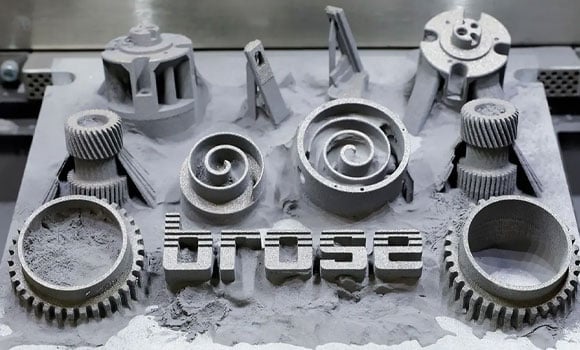
Using its proprietary AMP and PS spheroidisation processes, CNPC Powder will transform Brose’s steel scrap into AM-ready powders. According to the company, the recycled powders consistently achieve high sphericity, excellent flowability, stable particle size distribution and low oxygen content—critical characteristics for reliable and repeatable Additive Manufacturing. The powders also meet international quality standards, including compliance with IATF 16949, ensuring they are suitable for demanding automotive production environments.
CNPC Powder states that its closed-loop recycling approach significantly reduces industrial waste while lowering reliance on virgin raw materials. This process also supports Brose’s long-term environmental, social and governance (ESG) objectives by cutting emissions associated with primary steel production. The initiative builds on CNPC Powder’s broader portfolio of sustainable materials, which includes 100% recycled Ti6Al4V Grade 23 powders with SCS certification and high-sphericity AlSi10Mg powders developed specifically for green manufacturing applications.
Brose, a privately owned German company, develops and manufactures systems for vehicle doors, liftgates and seats, along with electric motors ranging from 200 watts to 14 kilowatts for applications such as steering, thermal management and e-mobility. With approximately 31,000 employees across 68 locations in 24 countries, the company has increasingly adopted Additive Manufacturing to accelerate product development and reduce time-to-market.
To ensure that AM-produced prototypes accurately reflect series-production components, Brose uses original materials wherever possible. Jan Sander, Senior Expert for Additive Manufacturing at Brose, explained that the new “Green Steel” powder consists entirely of recycled stamping waste from Brose’s own press shops, while retaining the same chemical composition and mechanical properties as conventional sheet metal. This ensures machine compatibility and supports the broader goals of a circular economy.
Eric Fritzsche, Head of Additive Manufacturing at the Brose Group, added that the integration of component design, recycled materials and innovative AM processes is central to Brose’s vision for next-generation automotive manufacturing. While Green Steel powder is still undergoing evaluation for potential volume production, the collaboration represents a significant step toward scalable, low-carbon Additive Manufacturing in the automotive industry.