
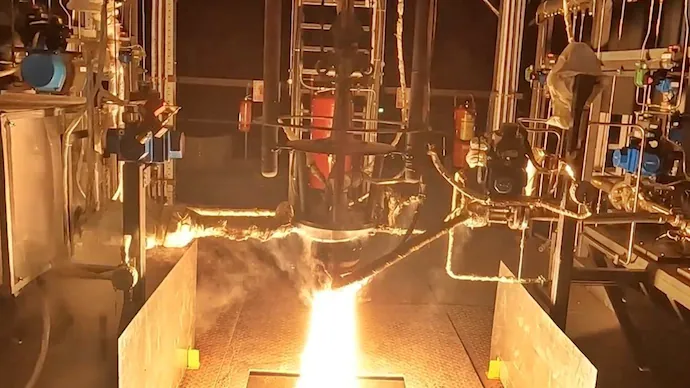

Agnikul Cosmos achieves breakthrough in rapid rocket engine manufacturing with Agnite booster test!
Agnikul Cosmos has marked a major milestone in its propulsion programme with the successful test of its Agnite booster engine, demonstrating a significant leap in rapid rocket engine manufacturing using advanced 3D printing technologies. The achievement highlights the company’s capability to drastically compress production timelines while advancing scalable launch solutions.
At the core of this breakthrough is Agnikul’s ability to manufacture a complete rocket engine in approximately seven days—a process that traditionally takes several months using conventional manufacturing methods. This dramatic reduction in production time is made possible through large-scale additive manufacturing, enabling the company to build complex engine components as a single integrated structure.
The Agnite engine, measuring about one metre in length, has been produced as a single-piece Inconel structure, making it one of the largest additively manufactured rocket engines of its kind. This monolithic design eliminates the need for multiple assembled parts, reducing potential points of failure while improving structural integrity and reliability. Such an approach also simplifies manufacturing workflows and enhances repeatability.
Another key innovation demonstrated during the test is the use of electrically driven pumps. Unlike traditional turbopump systems, electric pumps offer a simpler and potentially more efficient solution, reducing mechanical complexity and improving control over propulsion systems. This shift represents an important step toward next-generation rocket engine design focused on efficiency, reliability and ease of operation.
The test was conducted at Agnikul’s dedicated facility in Chennai and builds on a series of progressive propulsion trials carried out by the company. Earlier demonstrations, including the simultaneous firing of three semi-cryogenic engines, laid the groundwork for this latest achievement. The Agnite booster test is now considered one of the company’s most significant advancements since its controlled ascent mission in 2024.
By significantly reducing manufacturing timelines, Agnikul aims to transform launch readiness. The company envisions a future where satellite launches can be scheduled within days rather than months or years. This capability is particularly valuable for customers requiring dedicated launch services, precise orbital insertion and greater flexibility in mission planning.
Agnikul’s business model further strengthens this value proposition through vertical integration. The company brings together rocket manufacturing, propulsion development, mission control and ground infrastructure within a single ecosystem. This integrated approach reduces reliance on multiple vendors and simplifies the launch process for customers, enabling end-to-end service from mission planning to deployment.
From a strategic perspective, the design philosophy behind the Agnite engine focuses on reducing complexity while improving reliability and enabling reusability. Features such as single-piece construction and electric pump systems contribute to faster turnaround times between launches, supporting higher launch frequency.
With key propulsion risks now significantly mitigated, Agnikul Cosmos is shifting its focus toward achieving consistent launch execution and scaling its operations. The company aims to support a wide range of applications, including satellite constellations, government missions, technology demonstrations and emerging use cases such as space-based computing.
This breakthrough positions Agnikul Cosmos at the forefront of innovation in the private space sector, reinforcing India’s growing capabilities in advanced aerospace manufacturing and rapid launch technologies.