Mitsubishi Electric Automation Unveils Robotic Machine Tending Solutions to Boost CNC Manufacturing Efficiency!
Mitsubishi Electric Automation Inc. has introduced its latest robotic machine tending solutions, LoadMate Plus and ARIA (Automated Robotic Industrial Assistant), at IMTS 2026, demonstrating how pre-engineered automation systems can help manufacturers improve productivity, maximise machine utilisation, and simplify the adoption of industrial robotics. Designed specifically for CNC mills and lathes, the two solutions provide flexible, scalable, and easy-to-implement automation options for manufacturers seeking to increase operational efficiency while addressing labour shortages and rising production demands.
As manufacturing industries continue to embrace smart automation and Industry 4.0 technologies, robotic machine tending has emerged as one of the most practical and cost-effective methods of improving shop floor productivity. By automating the repetitive process of loading and unloading components from CNC machines, manufacturers can significantly increase spindle utilisation, improve production consistency, reduce manual intervention, and enable unattended or lights-out manufacturing. Mitsubishi Electric Automation’s latest solutions are designed to make this transition easier by offering pre-engineered systems that reduce implementation time while providing the flexibility to adapt to different production environments.
Machine tending plays a crucial role in CNC manufacturing, particularly in industries where high-volume production, precision machining, and continuous machine operation are essential. Traditionally, operators spend a considerable portion of their time loading raw material, unloading finished parts, and monitoring machine cycles. Automating these repetitive tasks enables skilled workers to focus on higher-value activities such as process optimisation, quality assurance, programming, and production planning while allowing machining centres to operate more efficiently.
One of the primary advantages of robotic machine tending is the ability to increase spindle uptime. Since machining centres generate value only while actively cutting material, reducing idle time between machining cycles has a direct impact on productivity. Automated robots can load and unload parts quickly and consistently, minimising delays between operations and enabling machines to run continuously for extended periods. This increased utilisation translates into higher production output without requiring additional machine tools.
Mitsubishi Electric Automation highlighted these productivity benefits through live demonstrations of both the LoadMate Plus and ARIA systems at IMTS 2026. Visitors observed how the robotic cells seamlessly integrated with CNC milling and turning machines while maintaining reliable and repeatable part handling throughout the machining process. The demonstrations illustrated how automation can improve workflow efficiency while reducing dependence on manual labour.
According to David Simak, Product Manager (Service) at Mitsubishi Electric Automation, robotic machine tending represents one of the most practical and financially attractive entry points into factory automation. He noted that when properly implemented, robotic tending solutions deliver measurable productivity improvements within a relatively short period, making them an attractive investment for manufacturers looking to enhance competitiveness while managing labour constraints and increasing production efficiency.
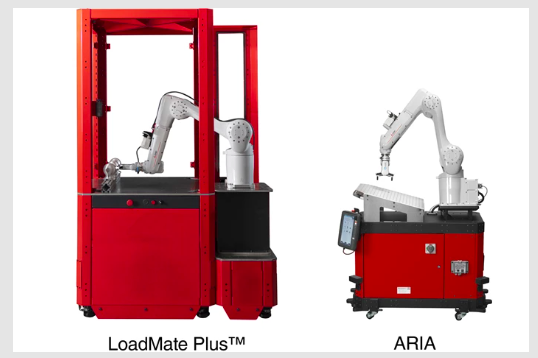
LoadMate Plus has been developed as a dedicated robotic tending solution designed for quick installation and long-term operation on individual CNC machines. The system can be customised to suit a wide variety of machine layouts, workpiece sizes, production requirements, and safety standards. Its modular design enables manufacturers to tailor the automation cell to specific machining applications while maintaining a straightforward implementation process.
A significant advantage of LoadMate Plus is its direct integration with Mitsubishi Electric CNC controls and industrial robots. Native compatibility simplifies system commissioning, reduces integration complexity, and enables reliable communication between the robot and machine tool. This integrated approach helps manufacturers achieve faster deployment while ensuring smooth and dependable machine operation throughout production.
Complementing LoadMate Plus is the ARIA (Automated Robotic Industrial Assistant), a compact and highly configurable robotic tending platform developed specifically for facilities where manufacturing space is limited. Designed for CNC mills and lathes operating in space-constrained environments, ARIA provides manufacturers with a flexible automation solution that can be adapted to changing production requirements without major modifications to existing factory layouts.
Unlike fixed automation systems, ARIA has been engineered for mobility and flexibility. The system supports multiple industrial robot models and can be relocated between machines or production cells as manufacturing requirements evolve. This portability makes ARIA particularly valuable for manufacturers producing a wide variety of components in small and medium production batches, where automation resources may need to be shared across multiple machining centres.
The ability to relocate robotic tending systems also supports phased automation strategies. Manufacturers can begin with automation on a single machine before expanding the solution across additional production lines as business needs grow. This scalability reduces initial investment risk while allowing companies to gradually increase automation throughout their manufacturing facilities.
Beyond improving machine utilisation, robotic machine tending contributes to greater process consistency and product quality. Automated loading and unloading eliminate many of the variations associated with manual handling, ensuring that components are positioned consistently during every machining cycle. This repeatability helps maintain tighter dimensional tolerances while reducing the likelihood of production errors and component damage.
Automation also supports safer manufacturing environments by reducing operator exposure to moving machinery, heavy workpieces, sharp cutting tools, and repetitive manual tasks. By transferring physically demanding activities to robotic systems, manufacturers can improve workplace safety while allowing employees to concentrate on more technical and value-added responsibilities.
Another major advantage of robotic tending is its ability to support lights-out and extended-hours production. Automated systems can continue operating during unattended shifts, overnight production, and weekends, enabling manufacturers to maximise equipment utilisation without proportionally increasing labour costs. This capability has become increasingly valuable as manufacturers seek to improve productivity while addressing skilled labour shortages across the industry.
The introduction of LoadMate Plus and ARIA reflects Mitsubishi Electric Automation’s broader commitment to helping manufacturers accelerate their automation journey through practical, flexible, and scalable solutions. By offering pre-engineered robotic systems that simplify integration while delivering measurable productivity improvements, the company enables manufacturers of all sizes to adopt automation with greater confidence and lower implementation complexity.
As demand for flexible manufacturing, shorter lead times, and higher production efficiency continues to grow, robotic machine tending is expected to become an increasingly important component of modern CNC machining operations. Mitsubishi Electric Automation’s latest solutions position manufacturers to improve operational performance, optimise workforce utilisation, and build more resilient, automated production environments capable of meeting the evolving demands of advanced manufacturing.