
06:34
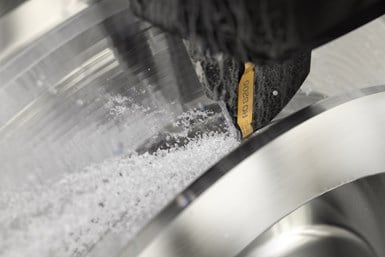
Sandvik Coromant has expanded its CoroCut® 2 parting and grooving platform with the introduction of four enhanced insert geometries, designed to improve process security, surface quality, and productivity in demanding machining applications. The latest additions focus on profiling in difficult-to-machine materials as well as parting-off operations where reliability, consistency, and reduced rework are critical for high-volume production environments.
At the centre of the update is the introduction of the -RO ground profiling geometry into the CoroCut 2 platform. This geometry is specifically developed for finishing operations in nickel-based heat-resistant super alloys (HRSA)—materials widely used in aerospace, energy, and other high-performance applications. By integrating the -RO geometry into CoroCut 2, Sandvik Coromant brings together advanced insert grades and the platform’s stabilising rail interface, resulting in improved wear resistance, enhanced dimensional accuracy, and the ability to maintain tight tolerances with consistent surface finishes. These improvements help manufacturers achieve predictable results in materials that are traditionally challenging due to high cutting temperatures and tool wear.
Alongside profiling enhancements, Sandvik Coromant has strengthened the CoroCut 2 offering for parting-off operations with three updated geometries—-CF, -CS, and -CR—each engineered to address common challenges such as pips, burr formation, and edge-line quality. These refinements are particularly valuable in automated and high-throughput production, where even small inconsistencies can lead to downstream quality issues or additional finishing operations.
The -CF geometry is a positive, light-cutting design that has been upgraded with CoroCut 2 insert grades and FlashLight™ technology. This combination delivers low cutting forces and improved edge-line quality, making it well suited for applications where stability and surface finish are priorities. Reduced cutting forces also contribute to longer tool life and lower energy consumption, supporting both cost efficiency and sustainability goals.
The -CS geometry features a ground design with a sharp cutting edge and a defined front angle to effectively minimise pips and burrs. Now supported by the CoroCut 2 rail interface, this geometry offers increased stability during cutting, particularly in sensitive parting operations where vibration and deflection can compromise results.
Completing the trio, the -CR geometry is a versatile solution designed to perform reliably across a wide range of materials. Its updated front angle helps reduce burr formation and pips, enabling consistent quality in mixed-material production environments and reducing the need for secondary deburring processes.
CoroCut 2 as a platform is engineered to deliver quality, efficiency, and process security across a broad spectrum of applications, including parting-off, external and internal grooving, face grooving, and profiling—from roughing through to finishing. The system uses two-edged inserts compatible with all ISO material groups, making it a flexible and cost-effective tooling concept for workshops seeking to standardise tooling while maintaining high performance.
Beyond productivity gains, the expanded CoroCut 2 portfolio also supports sustainable manufacturing by helping reduce material waste, rework, and energy consumption through stable cutting action and predictable tool life. With these latest profiling and parting-off geometries, Sandvik Coromant continues to address the evolving needs of modern production, providing manufacturers with tooling solutions that combine precision, reliability, and long-term operational efficiency.
Opt in today to our newsletter