
Beckhoff Expands MX-System Platform with New Size 3 Baseplates for High-Power, Cabinet-Free Automation!
By Ashutosh Arora
Beckhoff Automation has taken a significant step forward in cabinet-free machine design with the introduction of its new size 3 baseplates and larger function modules for the MX-System automation platform. This expansion opens up new opportunities for larger, more complex machines to operate entirely without a traditional control cabinet, furthering the company’s mission of modular, space-efficient automation.
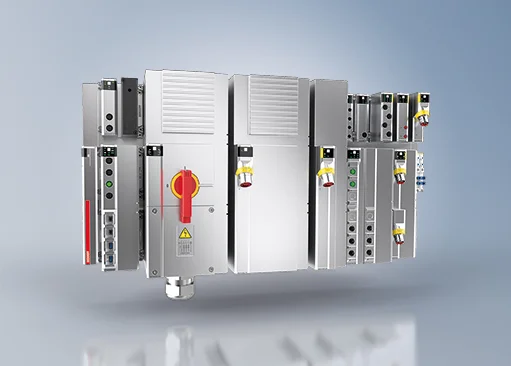
The new size 3 baseplate features an additional row of data slots, providing a substantial increase in available module connections within the same baseplate width. This enables machine builders to accommodate more pluggable function modules — whether size 1, 2, or the newly developed size 3 — without compromising footprint. While retaining the MX-System’s passive cooling principle, the larger surface area in size 3 allows for higher performance capacity, making it well-suited for demanding industrial applications.
The first set of size 3 function modules includes a 600 V DC supply with 40 A nominal current, a servo controller with 28 A nominal current, and a power supply capable of up to 63 A. Future additions will further extend capabilities, including modules for switching AC loads up to 16 A and feed modules supporting up to 125 A. This expanded range means the MX-System can now handle high-power applications that previously required a hybrid setup with a traditional control cabinet.
For machine topologies, the three-row baseplate can serve as a central hub in a combined star and daisy-chain configuration when paired with existing 1-row and 2-row baseplates. In compact machines, it can be used to fit the maximum number of modules in the smallest possible space, enabling a full replacement of the control cabinet while delivering the MX-System’s broad functionality.
By eliminating the need for bulky enclosures and enabling complete cabinet-free designs, Beckhoff’s expanded MX-System now supports a wider range of automation scenarios — from compact, high-efficiency systems to large-scale, high-power industrial machinery. This development marks a major milestone in modular automation technology, offering greater flexibility, reduced installation complexity, and a more streamlined approach to machine building.