
Toolmaker hits the ‘Mark’
0:00 / 0:00

With four generations of toolmakers in the family, Denmark Products Ltd has been expertly manufacturing injection mould tools since its inception in 1993. Started by father and son team Dennis and Mark Rowlands, it has come a long way since the 1990s. Testament to the journey is the recent investment in a Mitsubishi spark erosion machine from the Engineering Technology Group (ETG).
The small start-up on the outskirts of Telford manufactures precision injection mould tools for the automotive, medical and white goods industries. The company has added both a Mitsubishi wire EDM and a spark erosion machine to its plant list in a little over 12 months.
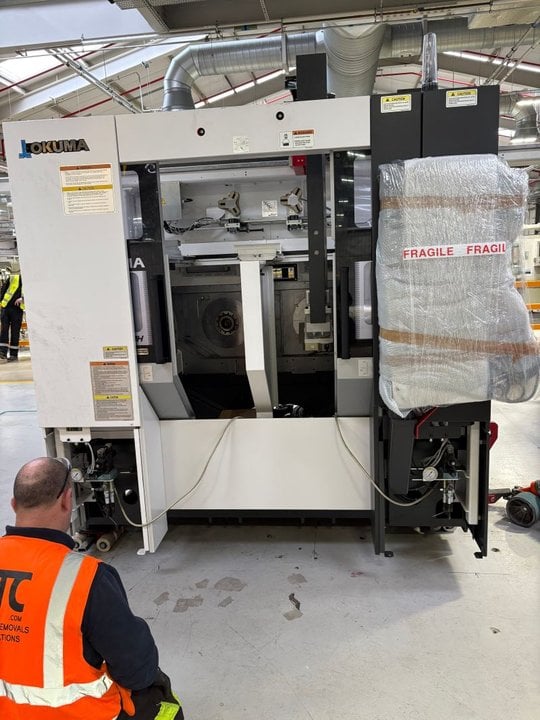
The seven-employee company was using an external supplier for its wire EDM requirements. This wasn’t an ideal situation with costs and process control being surrendered to the subcontract supplier. Recalling the situation, Managing Director Mark Rowlands says: “With the demise of so many companies through Covid, we had an opportunity to buy a used Mitsubishi MV1200S wire machine. As the UK supplier of Mitsubishi machines, we went straight to ETG for installation and commissioning support. In the 12 months since, we eliminated our subcontract wire EDM costs, and the associated lead times.”
With next-generation technology, the Mitsubishi MV1200S has significantly reduced lead times and improved throughput for Denmark Products.

Creating a spark
Ramping-up production post-Covid, Denmark needed to invest in a larger capacity machine. With three older spark erosion machines already on site, Denmark needed larger bed and tank capacity for processing larger dimensions of automotive interior trim parts and large white goods mould tools. The service provided by ETG with the MV1200S was a major factor in why the company invested in a second Mitsubishi machine.
As Mark continues: “We did our due diligence and looked at spark erosion machines from a few leading suppliers. Once we identified our capacity needs, it was the technology, capability and reputation of ETG that were factors in our decision to buy a Mitsubishi EA28V Advance spark erosion machine.”
The Mitsubishi EA28V Advance can accommodate maximum workpiece dimensions up to 1350 by 850 by 450mm in its 390 litre capacity tank that utilises an automatic elevation method. Discussing the work area, Mark adds: “We’ve been receiving requests for larger components that had to be externally produced, as our spark erosion machines were not big enough. This resulted in external subcontract costs that were a drain on our business and extended our lead times. With the arrival of the Mitsubishi EA28V, we have brought all of this work in-house.”
However, the Mitsubishi EA28V Advance has given Denmark so much more, as Mark continues: “The extra capacity allows us to process larger parts, it also enables us to put two or three different smaller jobs on the bed and run them consecutively. This means we can undertake lights-out machining, and in many instances, we can set the machine up on a Friday night to run all weekend unmanned. This is a huge saving for our business.”
“Our existing machines only have single-electrode capacity, which means that we would continually change electrodes for every operation and part. With the Mitsubishi EA28V, we can set up to 20 electrodes and the machine will run for a couple of days unmanned. This is a huge saving for our business. From a productivity perspective, the technology in the Mitsubishi EA28V means that we can adjust our settings to erode components at higher speeds and feeds or we can similarly slow the speeds to extend the life of electrodes. Regardless of the multitude of settings, the machine can process parts far faster and to a higher level of quality and precision than any of our other machines,” says Mark.

Another advantage for the small business is the reduction in hand polishing, as Mark adds: “Our existing spark erosion machines are typically generating a surface finish in the region of 24VDI (1.6Ra), which often requires considerable post-machining hand polishing. This is particularly the case for injection mould tools for interior vehicle trim components that are used in marque vehicle brands and medical mould tools for containers and spoons. With the new Mitsubishi EA28V, we are easily achieving surface finishes of 12VDI (0.4Ra), which has drastically reduced our hand finishing. On parts such as ribs and cavities, the surface quality has eliminated hand finishing, which is a necessity for sensitive features. Overall, bench finishing has massively reduced, freeing up hours for our machinists every week.”
Mark concludes: “The service from ETG has been exemplary. The knowledge and understanding of Scott at ETG are unfathomable. We initially did four days of training and Scott was giving us tips and tricks to enhance our processes further. Whilst the capability and productivity of the machine are impressive, the tips on process improvements from Scott were the icing on the cake.”