
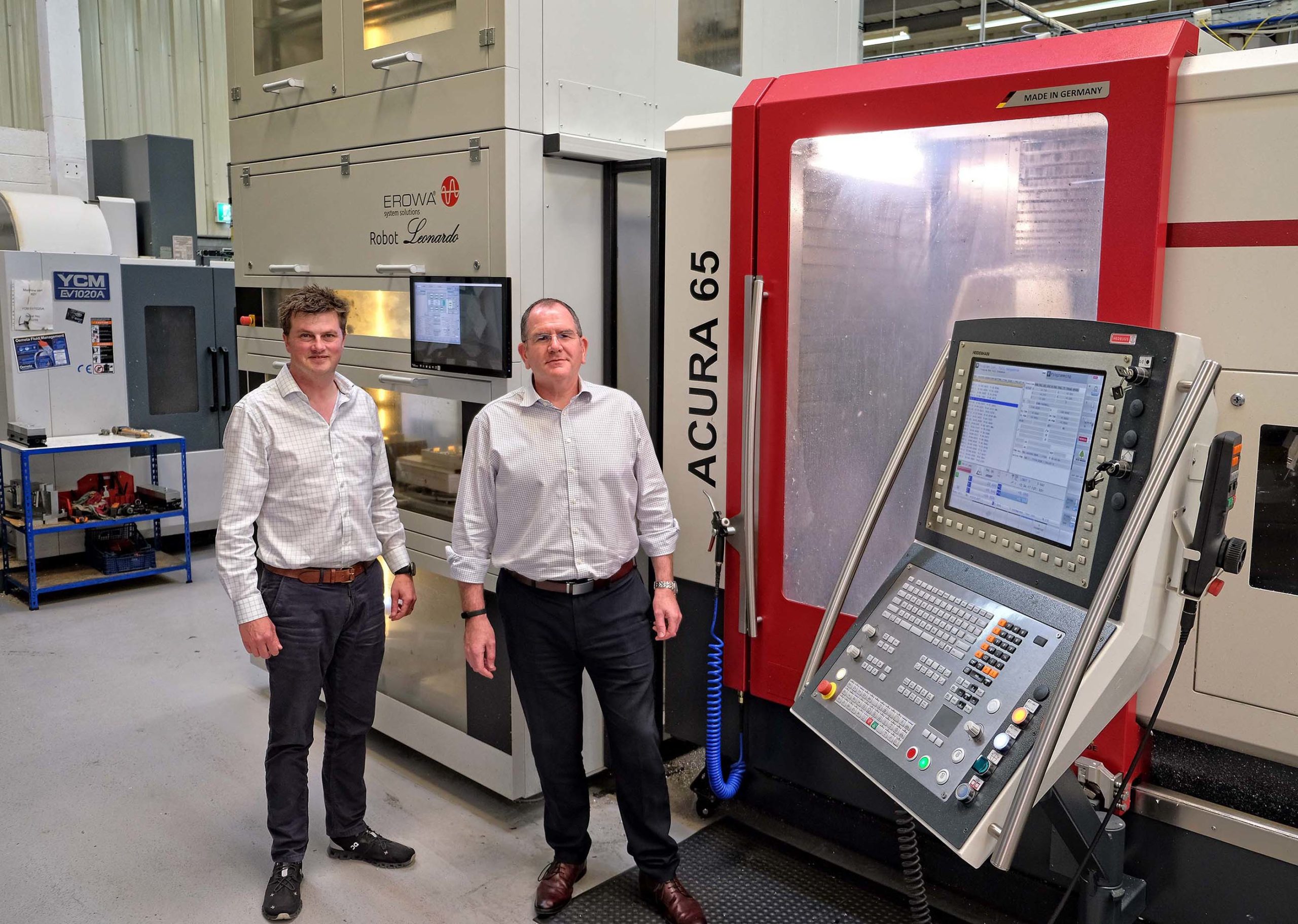
Remotely checking the status of machines on the factory floor is helpful for production managers to understand the reasons for idle times. One subcontractor using monitoring software that feeds data back from the shop floor to an office is aerospace subcontractor Automatic Industrial Machines (AIM) in Clevedon, North Somerset. Its three 5-axis machines (YCM, Hedelius and Mikron) and nineteen 3-axis and 5-axis stand-alone machines are all controlled by Heidenhain CNC systems that have been networked using the StateMonitor software.

Detailed knowledge and data collection for immediate troubleshooting and analysis has increased output considerably. Stoppages can be rectified quickly, while analysis over time allows the company to try out different methods for increasing throughput. Operators know the software is installed and relaying information on their actions over the network, so productivity tends to be higher. Long-term records are also useful for planning machine maintenance. Rob Kendall, Managing Director of AIM said: “Having access to data in real-time is what Industry 4.0 is all about.”
One automated YCM NFX380 5-axis machining centre served by an Erowa Leonardo pallet storage system showed that over 24 hours of unmanned running, depending on the components and the cycle times was often idle for the last three to four hours as it had run out of work. Six extra Erowa pallets were purchased, bringing the total capacity to 66 positions. This enables the cell to run for a full 24 hours. The extra parts produced per day have quickly started to amortise the cost of the additional pallets.
Mr Kendall is a long-time user of Heidenhain-controlled machines and the subcontractor was chosen in 2018 as a beta test customer to evaluate an early version of StateMonitor. Since then, Heidenhain has invested heavily in the development of StateMonitor software. The product is now fully fit for purpose and when it was presented to Mr Kendall in the latter part of 2022, it had progressed to such an extent that AIM was happy to evaluate it again. By January 2023, the subcontractor had purchased 22 licences for all the machining centres on the shop floor.
Heidenhain provided a turnkey service, during which the software was installed on AIM’s server where all programs are resident. Every machine’s Heidenhain TNC control is connected by an Ethernet cable. Two of six factory units communicate with the other four units over Wi-Fi to allow server access to data from remote machines.

85% of AIM’s turnover comes from the aerospace sector with the company producing aluminium structurals such as stringers and skin panels up to 6.5m long. The subcontractor additionally supplies the automotive, motorsport, electronics, food processing and fluid control industries.
Dave Kinch, Operations Manager at AIM, takes a pragmatic approach to his use of StateMonitor. Although 22 machining centres are connected, he tends to focus on five or six, notably the three automated cells, one or two stand-alone 5-axis machines and a machine devoted to titanium aero components. Regarding the latter, he noticed cutting parameters were 1% below optimal and adjusted them accordingly. It represented a small rise in metal removal rate, but over a year it is adding up to a measurable increase in throughput.
A vast amount of additional data is available, including job changes, program status and run time, tool changes, spindle speed and feed rates, override settings and other machining parameters, all of which may be useful for some companies.
“I have calculated that the YCM NFX380 5-axis production centre, served by the recently expanded Erowa Leonardo store with 66 pallet positions, is already 26% more productive due to the changes we have implemented based on information collected from the StateMonitor software.”
He added that the output from stand-alone machines is more difficult to assess, but he estimates that they are producing parts during the day shift for 83% of the time, versus an industry average of 65%.