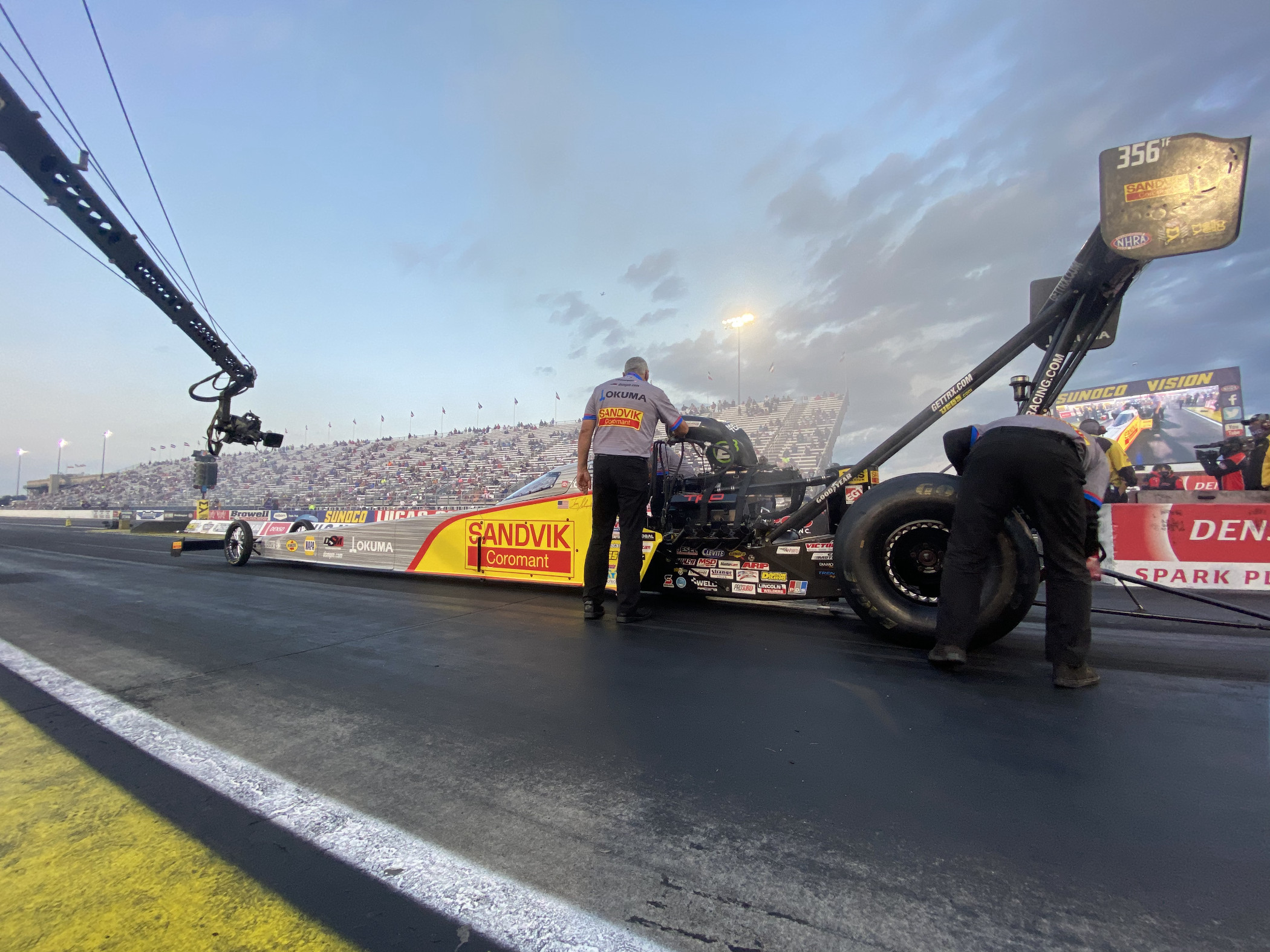
Henry Ford once said that ‘Auto racing began five minutes after the second car was built.’ Adaptability and automobiles go hand-in-hand, but precision parts manufacturer Don Schumacher Motorsports (DSM) has taken this idea into pole position. The company is winning on the racetrack, and now it has expanded into the aerospace and defense industries. However, it needed the right machine tools, which is why it turned to Sandvik Coromant.
In September, Matt Hagan gave Don Schumacher Racing (DSR) its 350th victory in the final round of the Lucas Oil National Hot Rod Association (NHRA) Summernationals at the Lucas Oil Raceway in Brownsburg, Indiana, US. Hagan raced to victory in his drag racer that can race from zero to 330mph in less than 3.7 seconds. His win also coincided with the 50th anniversary of company founder Don Schumacher’s victory at Indianapolis in 1970.
Today, DSR is one of motorsports’ elite teams. All four of DSR’s Dodge Charger SRT Hellcat drivers have claimed at least two victories throughout nine races in 2020 and DSR is the only team in NHRA history to have gone undefeated for 12 consecutive races in a single category.
DSR has also been notching up victories behind the scenes, specifically at DSM Precision MFG. In 2018, the company acquired ISO:9001:2015 certification. The shop’s other win has been against COVID-19. In just two years, the machine shop — founded in 2005 solely to support the company’s drag race program has diversified into a range of new sectors.

Now, says Chad Osier, Vice President at DSM, the Brownsburg machine shop is the only one of its kind in the Midwest that offers such a high degree of precision for such a wide range of sectors. “We’re all racers at heart. Racers are engineers and this expertise, and the right tools allow us to hit the levels of precision and quality when building nitro blocks for drag racing that produce 11,000 horsepower. Now we can bring that same precision to the defence, aerospace, commercial, motorsports and automotive industries.”
How has DSM achieved all of this in such a short time, and what can other manufacturers learn from it? As it turns out, a large part of the answer lies in DSM’s choice of machine tools. The name of their chosen tooling partner has adorned the side of Hagan’s car since 2017. The sponsor is Sandvik Coromant, co-branded with the machine manufacturer Okuma America.
“We are in the business of making a profit. Tool wear is a big part of that. We want to minimise as much waste and scrap as possible. The tooling and equipment from Sandvik Coromant go hand-in-hand with how we operate,” says Osier.
Racing to precision
DSM’s relationship with Sandvik Coromant goes back to 2012 and successful projects include helping the customer to move its production of aluminium engine blocks in-house. This has enabled it to produce more precise and better-performing components that win victories. DSM then sought help from Sandvik Coromant with its objective to become, what Osier describes as, a ‘full-on kind of general engineering machine shop.’ That is, one that can build project products ranging from small speciality fasteners to nitro engine block and bespoke aluminium parts for defense and aerospace.
“When relying on an outside partner for anything, there is a question of trust and Sandvik Coromant has consistent products that are high quality and long-lasting. It offers the engineering support to help us tackle any project,” says Osier.
Brian Flores, Channel Manager for the Eastern United States at Sandvik Coromant, agrees: “We support DSM from the local sales engineers to helping DSM’s automotive specialists and process improvement experts. That includes working closely with its team of specialist programmers to develop precision parts like piston heads or engine blocks.”

“These machining processes are very complex and Sandvik Coromant’s tooling is used in the Okuma machines that allow us to get the machined parts up to the necessary quality standards. This is where hard-wearing tools prove critical.”
For these applications, DSM relies on tools like the CoroMill® 390 shoulder milling cutters designed for versatility, with ramping capability for mixed production. With light-cutting insert geometries, the CoroMill® 390 is designed for low cutting forces and vibration-free machining.
Minimising scrap
To meet the ISO:9001:2015 standard, a company must demonstrate its ability to consistently provide products and services that meet statutory and regulatory requirements and second, is enhancing customer satisfaction by applying the system. For the shop floor, this is linked to DSM’s quality management system, but it also equals sustainability. For this, DSM also makes use of the CoroMill® 790 cutter for ISO N materials, designed for high precision work. The CoroMill® 790 cutter is a ‘super remover’ for effective chip removal.
“We look for tools that will produce consistent and repeatable parts and minimise our scrap and our cycle time. So, the biggest thing I get on sustainability is how we’re able to maximise our output and reduce our material scrap in automated processes,” explains Osier.
Flores adds: “This is a real challenge when making aluminium racing engines. The material removal is amazing and requires specific programming techniques and paths. That’s where I believe Sandvik Coromant shines, in helping DSM to find the most productive way to approach these parts.”
DSM understands that tool wear goes beyond the tools and includes effective monitoring, so it uses Sandvik Coromant’s CoroPlus® Machining Insights platform, an expansion of the CoroPlus suite of connectivity software. The platform is designed to give manufacturers greater visibility of CNC machine tools and machining processes. Furthermore, the shop was able to integrate the system seamlessly into its existing enterprise resource planning (ERP) system.
“We can track tooling performance. Tooling and equipment work hand-in-hand with our technology,” said Osier.
Eyes ahead
This high-tech approach doesn’t extend only to tooling but also to training. Since 2016, Sandvik Coromant has operated a 5,000sq/ft training facility on DSM’s shop floor, which symbolises the relationship between the two companies. Trainees gain hands-on experience of modern machining, tools and techniques and DSM hosts Sandvik Coromant’s customers in the regional area.
Osier adds: “It’s an excellent partnership and mutually beneficial for both companies — including as we reach further into the aerospace, automotive and defense industries. It has also exposed Sandvik Coromant to our large Tier 1 customer base, so they can experience first-hand the benefits and value of Sandvik Coromant products.”
Osier estimates that DSM’s production is now divided roughly 50-50 between racing and its general precision engineering contracts. The manufacturer will continue to build on this going forward, including investing in 3D metal printers.
“Precision and quality are critical in everything we do, and we use these Sandvik Coromant tools to meet those precision needs, both in the motorsports industry and the rest of the industries we work in,” explains Osier. “Their support delivers sustainability for us and without that, we can’t meet our obligations to our customers.”
Auto racing may have begun five minutes after the second car was built. But, with entrepreneurial flair and Sandvik Coromant’s tooling solutions, it looks as if DSM will continue leading the race for many years to come.