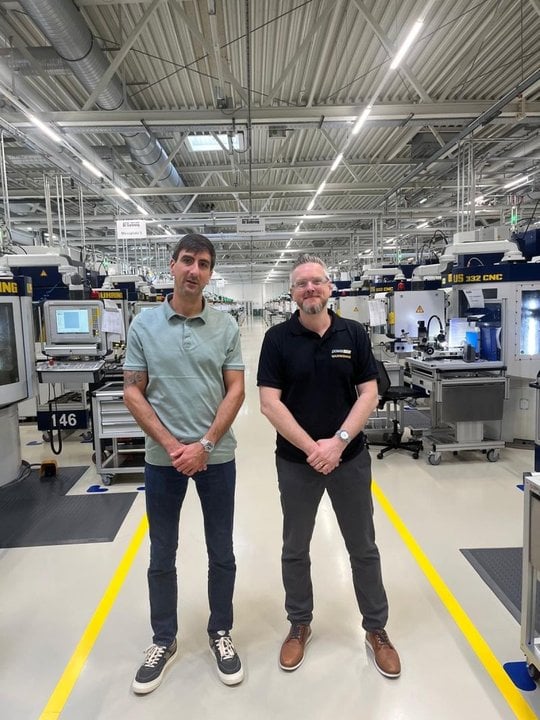
With traceability and conformance to standards increasingly important, Colchester Machine Tool Solutions has now introduced its latest range of component marking systems. MTDCNC travelled to the Colchester facility in Elland to find out more.
The TYKMA Electrox brand of marking machines now available from Colchester offers a diverse range of opportunities for manufacturers, so MTDCNC’s Lyndsey Vickers spoke with Paul Buckley about the latest Minilase XL machine the company has on show. Paul tells MTD: “The laser marking machines are designed for marking products to offer traceability within industry. Nowadays, a lot of products cannot go out of the door without being marked for traceability, whether it is serial numbers or codes. Our machines have the facility to pretty much mark anything. We can mark anything from cardboard right through to tungsten carbide. Our lasers are very easy to set up as they are almost straight out of the box and plug and play. They are supplied as a complete system with the software, all the connection cables and they run off a 240V supply.”
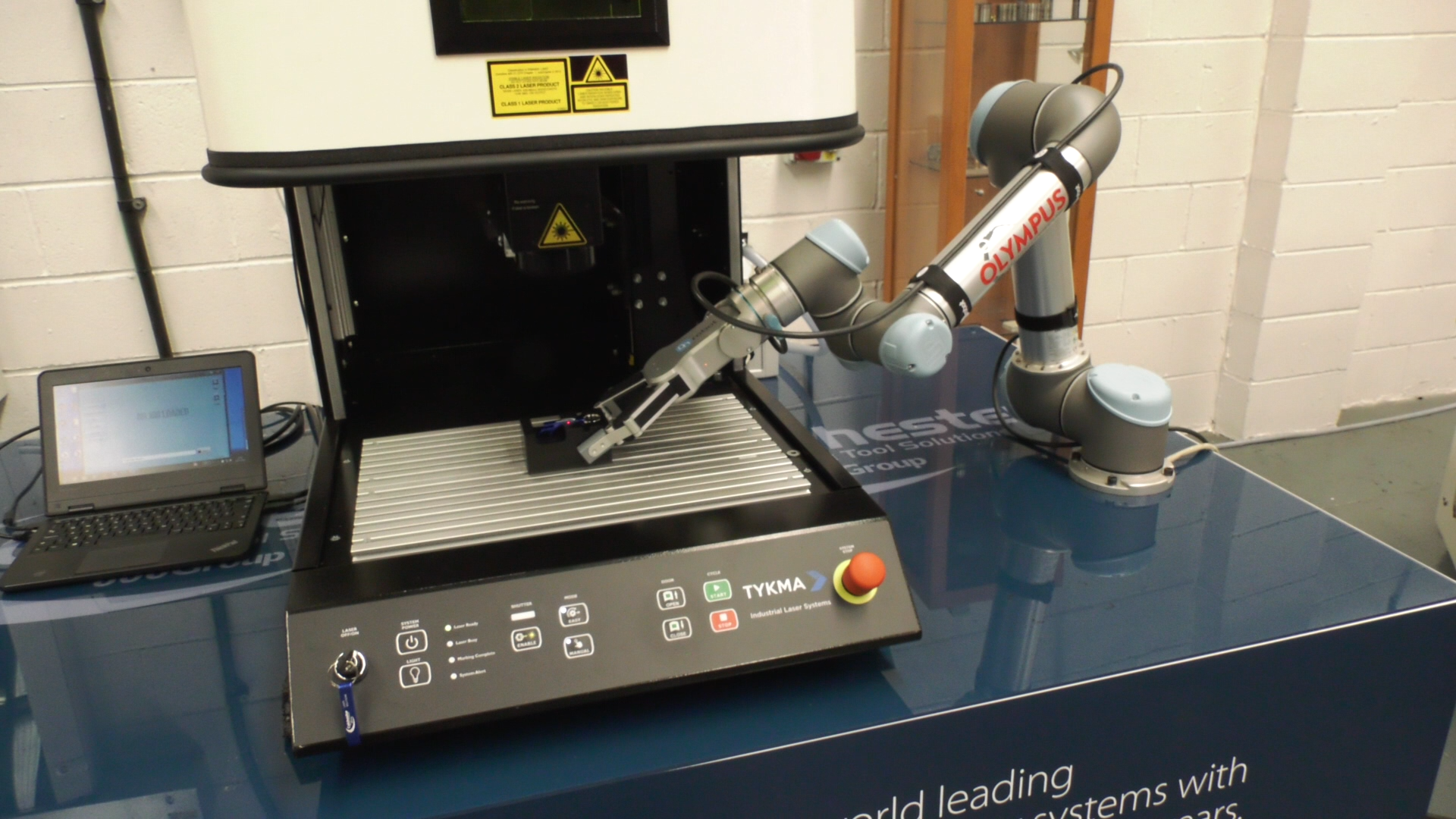
Alluding to the ease of use and the ability to slot a manual or even automated desktop marking solution into your business, Daniel Tyas from Olympus Technologies, the company that is providing robotic integration, says: “If you require laser marking, this is great because it is a ready to go system with no complex integration. It’s a robot out of the box, a laser out of the box and the install of a piece of software. Additionally, you may need half an hour of programming training and you can literally be in production.”
Describing the system, Daniel continues: “We have a UR5 collaborative robot, which is the mid-range cobot in the family. What we mean by collaborative is that it doesn’t always need external gaurding or safety measures like light scanners. This means that it can work directly alongside the
marking machine. The universal robot is available in three sizes with a size for every application and the primary advantage is that you can use the ‘free drive’ mode to manually move the robot around by hand. The benefit of this is much faster programming and less time on the teach pendant.”

Running through how quickly the system is to set up, Daniel says: “First of all you would write a program on the teach pendant. From here, the robot will pick the component and move it into the laser marking machine. The door will automatically close, the etching will take place, the door will open, and the robot will pick the completed part from the laser marking machine. The advantage of the universal robot is that it can also be used to close and open the door of the laser marking machine.”
Discussing the application range of the laser marking system Paul Buckley continues: “The main area of application is for traceability. However, we also have customers that use these machines for personalisation and for jewellery – there are lots of different applications. We have a very wide range of models available, and this goes from the Laser Gear BOQX through to the mid-range Minilase XL and onto the EMS 400 Zetalase XL, which is a four-axis machine that allows us to put in large trays of products or parts with a large marking area.”
Concluding on the integration of a universal robot, Daniel says: “The advantage of the robot here is that it is compatible with all of the Colchester laser machines. This simplifies integration with the opportunity for pallet loading, multiple part loading and single part processing of larger parts. This provides complete diversity for the customer with the potential to put it into any production environment without complex integration.”