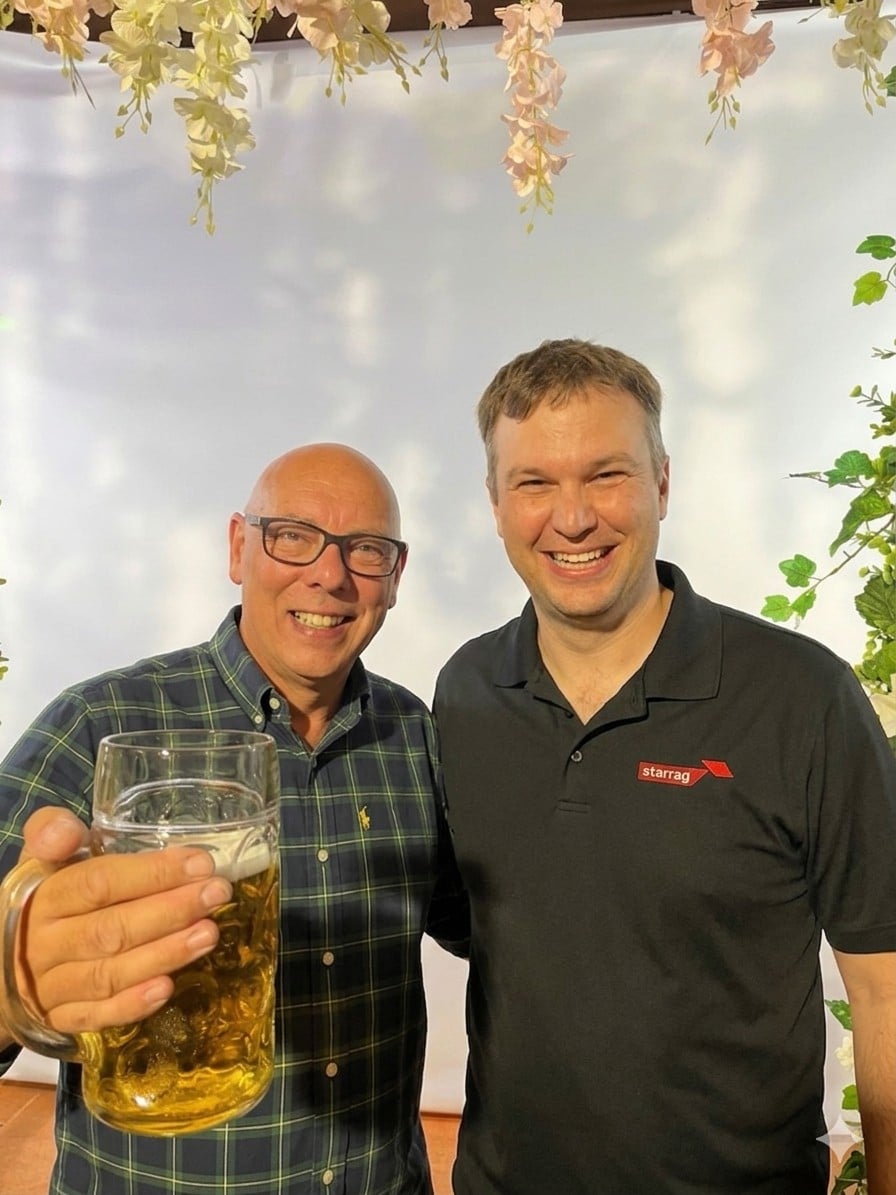
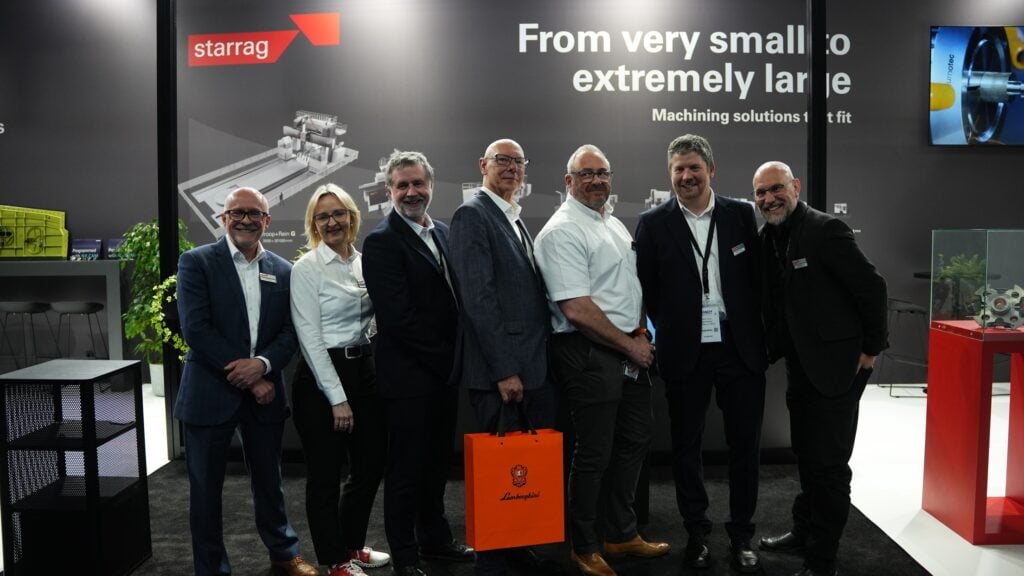
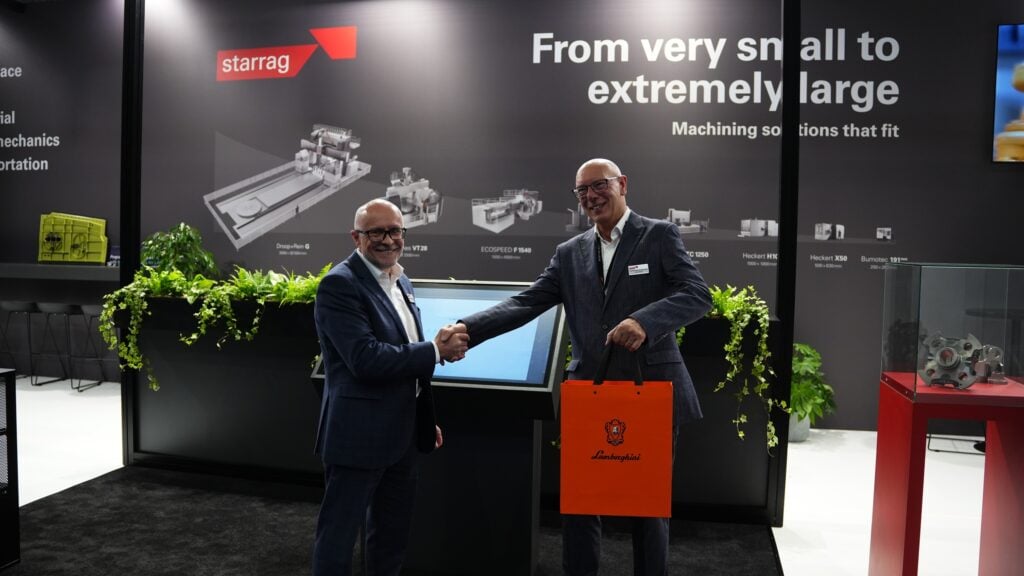
When Paul Zajac stepped off the Starrag stand at MACH 2026, he drew a line under an extraordinary machine tool career. An apprentice machinist in post-war Coventry, an applications engineer dispatched to the Iraqi desert during a live conflict, a sales director who took his shirt off mid-negotiation in a Chinese boardroom — and, for the past 16 years, one of Starrag’s most experienced salespeople for high-end aerospace and medical machining. In a conversation, Zajac reflects on the moments, mentors and machines that defined five decades in manufacturing.
Zajac entered the industry in 1974 at Alfred Herbert Ltd in Coventry, one of the largest machine tool manufacturers in the world at the time. “I’m not really an academic type person, so university was not going to be for me. My father always said: ‘Paul, go and get an apprenticeship, you’ll be set for life, and you’ll always find a job’.” Sound advice that so many of us heard when starting our careers.
Alfred Herbert sat alongside Wickman, Webster and Bennett, and a host of machine tool makers whose factory footprints shaped the region. For the young Zajac, it meant operating thread and surface-grinding machines — all manual machines, working 7.30am starts and four o’clock finishes. Alfred Herbert’s decline became a cautionary tale for the whole sector.
“A lot of companies didn’t change fast enough. They didn’t recognise the severity of the competition fast enough. That was certainly the effect of Alfred Herbert — it just started crumbling, and it got worse and worse.”
Inside the Matrix
From Alfred Herbert, Zajac moved to Matrix Churchill. Wanting to get into sales but knowing he needed a bridge, he applied for an applications role — a pivot he now identifies as one of the key decisions of his career. “I always wanted to try and get into sales in some form or another, but clearly you’re not going to do that from a machine shop. Applications seemed to be a good way to learn how to speak with customers, which I had no experience of at that time.”
The role took him around the world almost immediately. A commission to install an involute spline grinder in a remote Indian village with no international telephone line available. Making calls home meant flying to Calcutta to a phone. “I went for two weeks, but stayed six. I came back very ill with a real case of Delhi Belly, but it was certainly character-building.”
It was also during the Matrix Churchill years that Zajac absorbed the piece of advice he has carried throughout his career. “There was a guy who drummed something into me — you never give up on an order. You’ll always get another order, but you’ll never have that order. Once that one’s gone, you’ll never, ever get it.”
But defining the Matrix Churchill era and putting Zajac at the centre of a political scandal was the company’s supply of CNC lathes to Iraq during the Iran-Iraq War. Many of us will remember the ‘arms to Iraq’ scandal where Matrix Churchill had been acquired by London-based Iraqi investors, and machines were being shipped in significant volumes to Iraqi ordnance facilities. Export licences were granted by the UK government, and Zajac was in Baghdad as an applications engineer.
“Iraq obviously had a demand for ordnance to support their war, and they were going out to the world for machine tools. Matrix picked up a large order. The company eventually changed hands to the Iraqis, which gave them access to machines. This was perfectly legal, and export licences were granted by the UK government.”
So many machines were going over that the UK team began assembling them in kit form on-site in vast, hangar-like buildings in the desert. In the background, a war was being fought.
“You could probably call them sheds, but they were like an empty B&Q store with lines and lines of machines awaiting assembly. We could see where missiles had hit in downtown Baghdad. But again, you didn’t think about it at the time. I mean, you’re getting your £10 bonus for working in a war zone, and that’ll do.” When the political climate shifted, Matrix Churchill’s directors were prosecuted. The trial collapsed when a minister admitted in the witness box that the exports had been known about and implicitly sanctioned at the government level.
“So many companies were supplying Iraq, and the UK government didn’t want to miss the boat. The directors were in the Crown Court, and eventually a minister stood up and said, ‘This isn’t right — everything was known.’ The case eventually collapsed. There were lots of application engineers and lots of project managers involved. It was a huge, huge piece of business.”
“As all of this was going on, I was moved from the Applications Engineering department to my first Sales role in Export Sales, eventually covering Europe, the Middle-East and Far East markets, working with the Matrix Churchill selling agent network.”
Navigating Chinese negotiations required reading the room in ways that product knowledge alone could not prepare you for. On one occasion, it called for a rather more dramatic intervention. “We got to the stage where we were just sitting across the table looking at each other. There was nothing else to say. So, I stood up — I took my shirt off, put it on the table and said: ‘You’ve got everything now, just take it’ – you should have seen the reaction from the table. We shook hands. It was just a case of breaking that deadlock.”
A household name
Zajac’s career then led him to Bridgeport — the iconic British manufacturer whose Leicester factory produced over 1,400 machines per year at its peak. In the late 1990’s, Zajac was the UK and export Sales Director, but the landscape was shifting under price pressure from the Far East and the US. Rather than compete on price, the company championed leasing — borrowing from the automotive sector’s model for making premium brands accessible.
“It made BMWs and Mercedes affordable for everybody — so why couldn’t that work for machine tools? The resale value of 4-5 year old Bridgeport machines was very high compared to lower-value competitors. The cost to lease was brought closer together, companies could afford it, and they could change their machines every three or five years. We were looking at ways to maintain volume.”
When Hardinge acquired Bridgeport, Zajac moved into export sales, managing distributor relationships across Europe, China, Russia and Eastern Europe.
The Final Act
Zajac joined DST, which was subsequently acquired by Starrag, a company where he has spent the final 16 years of his career. It was the Ecospeed machine with its parallel kinematic Z3 head that crystallised his passion for aerospace manufacturing. This 5-axis platform, with no conventional rotary axes, is capable of removing large volumes of material from structural aluminium in ways no other machine could match.
“It is so different to any other machine on the market. The first installations were back in the early 2000s, and its capabilities still lead the market even now. Trying to explain to a customer that it’s a 5-axis machine with no rotary axes — at that time, they were astounded by that.”
The appeal of aerospace has always been rooted in the final part and the extraordinary demands placed on every component that comes near an aircraft.
“You don’t want anything failing in the air, so everything has to be structurally sound – the machining is critical. You can’t be damaging the material by machining too heavily. Some of the structural parts have very thin walls that are liable to vibrate. The application engineers just do a brilliant job getting over those issues.”
Paul’s largest single order was for upward of £16 million for just two machines, for an automated cell producing wing skins. More recently, the medical sector has become equally compelling. Robotic surgical systems demand micro-components at extraordinary volumes, and Zajac has been adapting multi-spindle milling platforms to address contracts of 600,000 single-use surgical clasps per year.
“As single-use instruments, someone has to make a lot of these. We’ve started looking at multi-spindle machines and how to adapt machines to do high-volume parts. You can cut the cycle time down from probably eight minutes to around one and a half minutes. Some of the clasps are tiny — you struggle to see them, and it makes this arena a fascinating challenge.”
The Road Ahead
Zajac is broadly optimistic about the state of UK manufacturing, pointing to reshoring, rising defence investment, and the fact that every Airbus wing is still built and assembled in the UK as evidence that the industry has found its purpose. “I think we are a country of good engineers. All Airbus wings are made in this country — assembled here and then flown down to Toulouse. We had a big shock during COVID where large organisations couldn’t get what they needed. Nothing was being shipped from the other side of the world. There’s been a lot of reshoring, and the components being reshored have good value. The industry, as a whole, is not in too bad a shape considering.”
And for anyone considering a career in the sector, his message is simple. “I think it’s a great industry to be in. Machine tools haven’t finished developing; they’re going to develop further. And if I’m honest, the industry is a lot sexier now than it was in the 1980s.”