

Productive Machines ‘Know the Drill’
0:00 / 0:00
As a deep tech Industry 4.0 company that is a spin-out from the Advanced Manufacturing Research Centre (AMRC) in Sheffield, Productive Machines work with manufacturers to help them get the best out of their machine tools – reaching the best possible quality of part, faster, the first time.

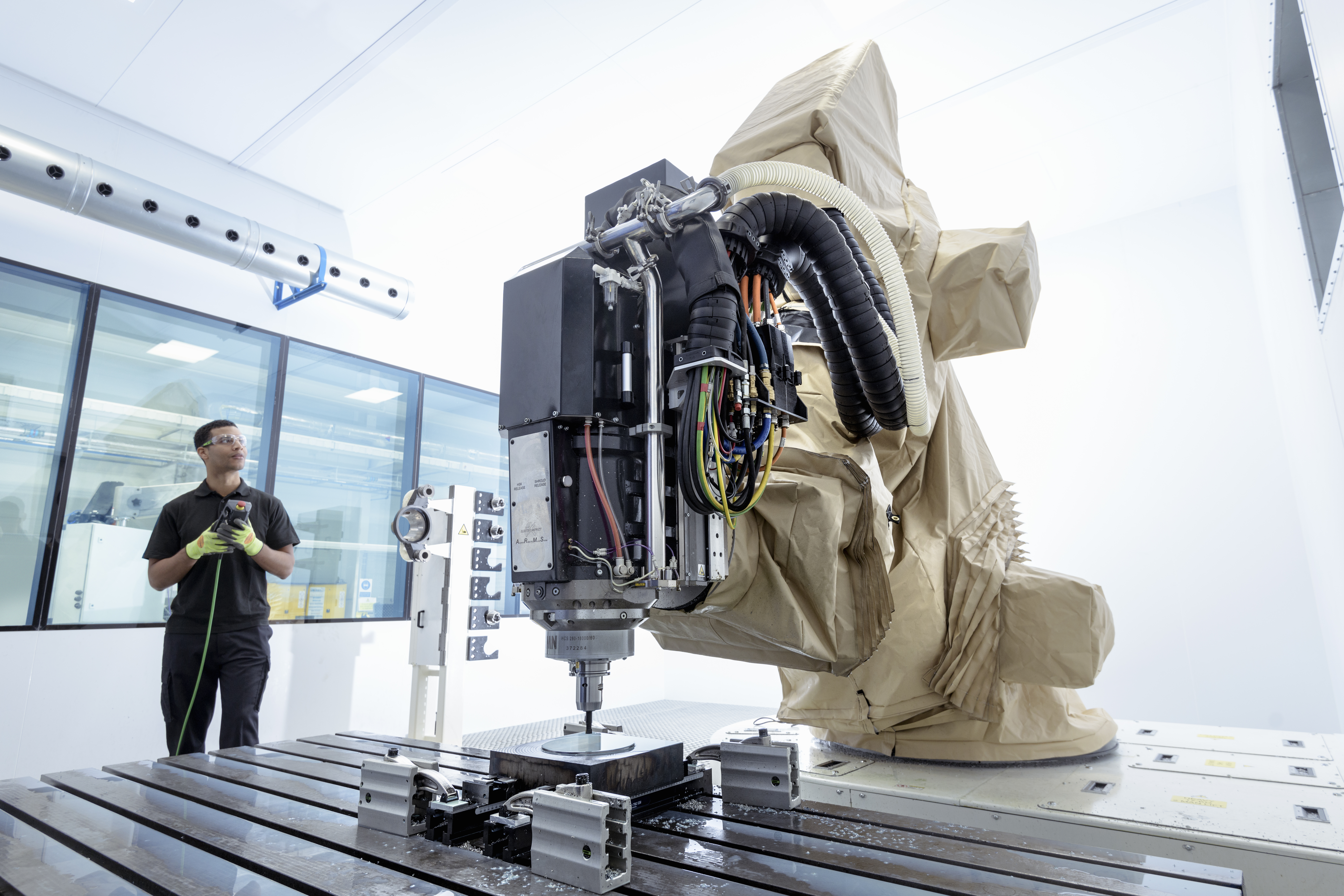
Recently, Productive Machines were invited to participate in a Seco Tools project to develop their understanding of the dynamics of robotic machining with the aim to test and maximise the capability of their new tools on a carbon fibre reinforced polymer (CFRP) material. The machining trials took place at the AMRC’s Factory 2050 using the AMRC’s KUKA Titan robot. The robot has been equipped with additional encoders in the joints and a Siemens Sinumerik control system.
The AMRC is part of the UK’s High Value Manufacturing Catapult network of world-leading research and innovation centres working with advanced manufacturing companies around the globe. As one of the world’s largest providers of comprehensive metal cutting solutions for milling, stationary tools, hole making and tooling systems, Seco has considerable input in projects at the AMRC. For over 80 years, Seco has been developing and supplying its technologies, processes and support to manufacturers striving to maximise their productivity and profitability.
The Challenge
Robotic machining is an emerging technology when it comes to processing large composite components. Machining robots can be a more cost-effective solution for large workpieces in comparison to standard machine tools and the flexibility of robots over machine tools offers several benefits. In 2021, there were three million industrial robots worldwide, a figure that grew 14% from the year before. Although most of these robots are used for things like welding and handling, the use of robots for processing tasks such as machining grew by over 37%.
There are exciting applications for robotic machining in the aerospace, automotive and marine technology sectors where large composite components are increasingly used for structural elements. The airframes of the future are set to contain an ever increasing number of CFRP components and assemblies to meet light-weighting targets. The benefits of composites for these applications are their strength to weight ratio compared to traditional materials such as aluminium, steel and titanium. This makes CFRP composites a good choice to minimise the weight of the vehicle without compromising its integrity and durability. 
The main drawbacks of machining robots are their high dynamic flexibility and relatively low positional accuracy. This results in early onset of chatter, vibration and high dimensional errors with poor surface finishes and potential delamination of the CFRP. To minimise these issues, technological solutions in process planning and control are needed. To this end, experts in robotic and process modelling are required to further develop the use of robots in machining composites.
With the compromised nature of stack machining in structures like CFRP airframes, holes must be drilled in situ without then taking assemblies apart or subsequently undertaking secondary inspection or rework. This necessitates a ‘right-first time’ approach to hole generation and this requires a deeper understanding of the dynamics of robotic machining.
Finding The Solution
As part of this ongoing research into CFRPs and robotic machining by the AMRC and their partners, the performance of newly designed Seco cutting tools were tested on CFRP composite material using the ARMS (Accurate Robotic Machining System) at Factory 2050.
To help further develop the understanding of the robotic machining of CFRP material, Productive Machines were invited to contribute to the project by finding best the process parameters for the robotic machining system. To do this, Productive Machines was commissioned to predict the process characteristics such as cutting forces and stability during drilling.
 Productive Machines’ technology can predict cutting forces, tool deflection and stability against chatter and vibration. This technology is used to predict possible process induced problems as well as component quality in advance. This leads to benefits such as higher-quality end products, improved productivity, reduced waste and extended tool life.
The project carried out at AMRC’s Factory 2050 using the ARMS robot was tasked with machining a series of holes with different diameters using two different tools (12mm and 16mm). The intention was to select the optimal machining parameters for the robotic machining setup. The test also targeted the performance of the cutting tool under different machining parameters.
Process characteristics were modelled and predicted by Productive Machines’ technology and the best combination of machining parameters were identified for the robotic machining setup. Experimental data was also collected for process monitoring and validation purposes through a cutting force dynamometer and accelerometers.
The engineering teams also analysed the stability of the process to check for vibration using their unique stability map. The predictions showed there was no vibration or instability at the chosen parameters. When plotted on a stability lobe diagram, the selected parameters all fell within the stable region.
Having made sure that chatter vibrations would not be present, the machining trials were run with a selected combination of machining parameters for testing the performance of new Seco cutting tools. The experimental data was used to further validate the predictions and cutting tool performance.
In a production setting outside of the research centre, the same techniques can be attained and put into practice by manufacturers that work with Productive Machines. Manufacturers can specify the Productive Machines technology to eliminate costly trial and error and minimise the lead time to reach optimal cycle times and component quality. Had the AMRC trials had a broader scope, the next step for Productive Machines would have been to run full simulations of the process and optimise the parameters to improve productivity and mitigate any tool deflection without generating instability.
 By running the simulation, Productive Machines can test hundreds of thousands of combinations of machine settings and arrive at a level of optimisation that would be difficult to achieve with years of continuous improvement. The benefits of this approach include less wasted time, less wasted material and scrap, extended machine uptime and improved tool life as well as increased productivity. In extreme cases with live clients, productivity improvements of over 100% have been generated with tooling cost reductions by more than 25%. Even when working with advanced toolpaths that have been pre-optimised manufacturers can increase productivity by 15%.
 Additionally, Productive Machines’ stability map can predict chatter instability in a process and suggest the best process parameters throughout the machining cycle. This enables manufacturers to produce the best part, faster, the first time.
It’s easy to try Productive Machines if you have machining challenges. The Productive Machines offering is currently service-based and it is moving toward an automated route. There is no need to install any software or take any training courses, the input is via a CAM file. For chatter mitigation, the tooling assembly’s frequency response function needs to be measured by tap testing.
The results of the demonstration were shared and discussed at ‘The Seco Aero ITI’ event that took place at Seco’s Innovation Hub in September 2022. Productive Machines was able to demonstrate its capabilities to many of Seco’s partners and clients. At the Seco event, Productive Machines founder Dr Erdem Ozturk was invited to take part in a panel discussion alongside Daniela Sawyer from the AMRC, Mark Walsh and Jason Smith from Seco Tools. You can access an on-demand edited version of this video at their YouTube channel: www.youtube.com/@productivemachines