

Rollomatic is Femto Fast
0:00 / 0:00
With new machines continually being developed, it’s not that often that you come across something far ahead of anything else and operates on such a high technical level that one can only marvel at the engineering development. By Chris Boraston Advanced Grinding Solutions Ltd
Engineers are always chasing seconds; especially when it comes to reducing cycle times. Over the years, Advanced Grinding Solutions has been tasked with achieving cycle time savings. However, understanding how Rollomatic’s latest laser machine for manufacturing PCD and other special tooling, requires a different level of understanding.

A microsecond is one millionth of a second, a nanosecond is one billionth of one second, and a picosecond is one trillionth of one second. All are very short and fast but the Rollomatic LaserSmart® 510 Femto Laser machine works in femtoseconds. A femtosecond is one quadrillionth of one second or a million billionth, of one second or 1,000,000,000,000,000th of one second. At this level, numbers can get a little hard to appreciate. One way to look at this is in terms of how far light can move in a given amount of time. Light travels about 186,000 miles in one second. That means it travels about 30 centimetres in one nanosecond. In one femtosecond, light travels just 300 nanometres — just slightly larger than the smallest bacteria.
The Rollomatic LaserSmart machines were first shown over 10 years ago at the IMTS exhibition in Chicago – but they have been further developed by Rollomatic. Noticing the developments using short-pulse lasers or so-called cold source laser systems for human eye surgery by the medical industry, Rollomatic has seen how the super-fast lasers could be used for manufacturing cutting tools and inserts and the Rollomatic 510 Femto machine is the pinnacle of that work. This machine has now been taken up by major PCD, Diamond and CBN cutting tool manufacturers such as Paul Horn and DTS. The laser machines have been given their dedicated production line within the Rollomatic machine tool plant in Le Landeron, Switzerland. Operating in femtoseconds brings some major advantages when looking to manufacture PCD, ceramic, CVD diamond and PCBN cutting tools. This is the world’s first femtosecond ultra-short pulse laser cutting machine for ultra-hard materials with 30% faster feed rates when compared to conventional laser machines with a pulse width 1,000 faster than pico lasers.

Rollomatic is understandably secretive when it comes to specifying machine settings, but the laser machining process has many parameters that influence the cutting result. However, the main variable parameters are the power of the laser, the wavelength, frequency, pulse length and the machine tool axis speed. The Rollomatic software ensures the operator only has to select the type of material to be machined and the recommended settings are automatically recalled.
The laser pulses are so short that zero heat is produced; the laser beam is simply not in direct contact with the cutting tool surface for a long enough amount of time for any heat to be generated. Even when working in picoseconds or nanoseconds tiny particles of dust are melted and you can suffer from temperature transfer issues that effect the surface structure of the cutting tool. The femtosecond pulses simply laser away, micron by micron, and the material is immediately vapourised. The latest Rollomatic laser machines are 450% faster than the last generation and some 500% faster than the conventional EDM process that is most often used to machine PCD tooling. The process creates cutting edges with a radius of under 0.5µm but end-users are also able to freely define the desired edge condition with a 3, 6 or 9µm radius.
PCD tools often require a mirror-like surface finish. The machine can achieve a surface finish of just 0.048µm Ra on a primary relief of a profile insert in PCBN material. A super mirror-like finish is generally twice as rough as that and finishes to this level cannot be achieved by processes like EDM or grinding.
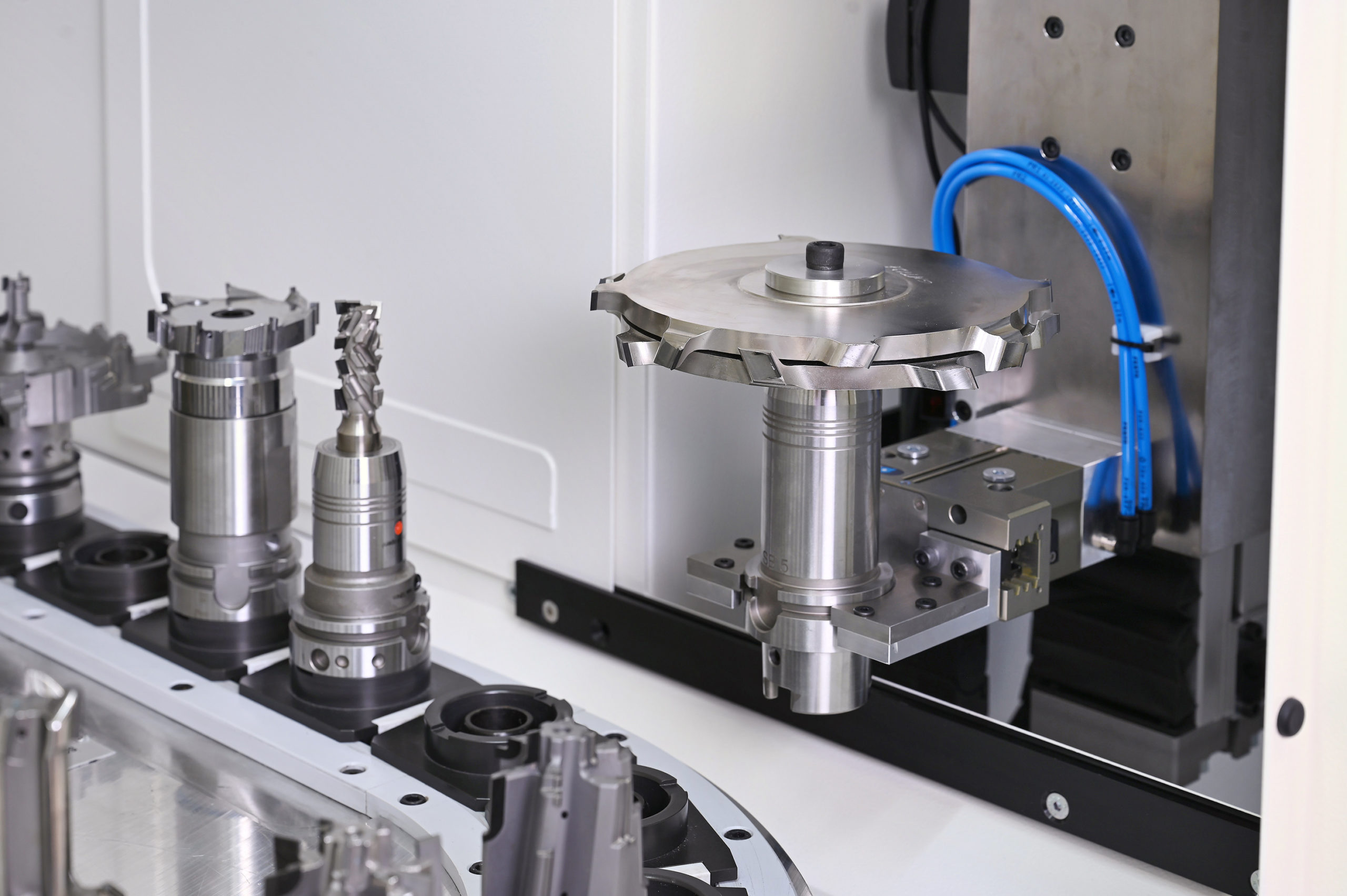
Rollomatic now offers the LaserSmart 510, the LaserSmart 510 Femto and the new LaserSmart 810 XL machine. The 510 versions have been developed for machining smaller tools whereas the 810 machine is used for producing larger PCD cutting tools. Apart from producing PCD tools, the machines can process ceramics, tungsten carbide, sapphire, glass or other ultra-hard materials and the machining process is automatically adapted to suit the chosen material.

The 510 machines have a general working range for producing tools of up to 190mm in length and from 0.1 to 80mm in diameter. The larger 810 machine produces tools up to 350mm in length and up to 300mm in diameter with a weight of up to 15kg. The latest 810 XL machine can be equipped with up to seven cameras to ensure the process can be monitored during production. The machine also benefits from a patented 6th CNC axis for smoother and faster sweeps of the laser beam. Despite operating at levels using femtosecond speeds, Rollomatic did not stop development there. The latest 810 machine uses a granite bed and now has a 3D-printed ceramic axis that is 3 times lighter and more rigid than cast iron.
Sven Peter, Rollomatics Laser Product Manager, further clarifies the positioning of the laser machines: “Many sectors rely upon the use of diamond tooling which is now irreplaceable as a cutting material in the form of CVD layers or as a PCD tip. However, the unsurpassed hardness that makes it so valuable often limits the tool geometry. With the laser machines from the LaserSmart series, such restrictions are overcome. Using the speed and precision of the Femto laser, boundaries are lifted, both in terms of tool design and quality. The demand for such tools across all industries is rapidly increasing and these can now be produced not only much better but also considerably faster thanks to the Rollomatic laser technology.”