

Sensory Robotics Introduces Intelligent 3D Safety System to Enable Safer and More Efficient Human-Robot Collaboration!
Sensory Robotics has launched an advanced 3D safety system designed to transform the way industrial robots and human workers interact on the factory floor. The new technology enables robots to operate safely alongside people without the need for traditional safety fencing, helping manufacturers improve productivity, maximize floor space utilization, and create more flexible production environments.
As industrial automation continues to expand across manufacturing sectors, one of the biggest challenges facing manufacturers is balancing worker safety with operational efficiency. Conventional industrial robots typically operate inside protective cages or fenced-off areas to prevent accidental contact with workers. While these safety barriers are effective, they consume valuable floor space, restrict workflow flexibility, and limit opportunities for collaboration between people and machines. On the other hand, collaborative robots, or cobots, are designed to work near humans but often operate at reduced speeds and lower payload capacities to meet safety requirements.
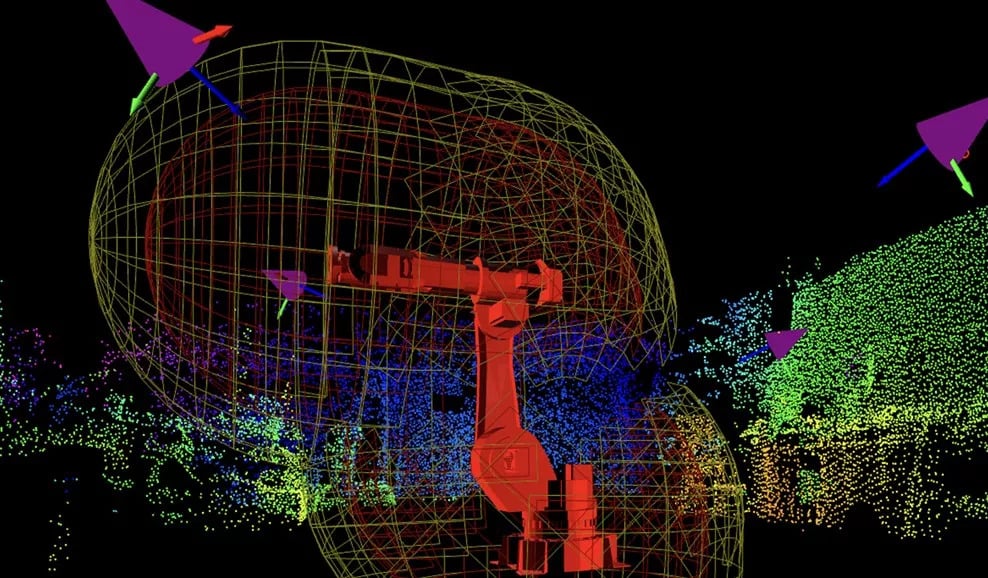
Sensory Robotics’ new 3D safety solution aims to bridge this gap by allowing high-performance industrial robots to work in shared spaces while maintaining rigorous safety standards. The system utilizes advanced 3D time-of-flight sensing technology that continuously monitors the environment surrounding a robot in real time. By creating a dynamic and constantly updated safety zone, the system can accurately detect the presence, position, and movement of people or objects within the robot’s operating area.
Unlike traditional fixed safety systems, the intelligent monitoring technology enables the robot to automatically adjust its behavior based on real-time conditions. When the workspace is clear, the robot can operate at full speed and maximum productivity. As a worker approaches the monitored area, the system responds by gradually slowing the robot’s movement to maintain safe operating conditions. If a person or object enters a predefined restricted zone, the robot immediately stops, preventing potential accidents and ensuring worker protection.
This adaptive approach to safety offers manufacturers a significant advantage over conventional guarding methods. Instead of isolating robots behind physical barriers, facilities can create collaborative work environments where workers and automated systems operate more efficiently within the same production space. The result is improved workflow, reduced facility footprint requirements, and enhanced manufacturing flexibility.
The technology addresses a long-standing limitation within industrial automation. Traditional safety fencing has been a necessary component of robotic installations for decades, but it often creates bottlenecks in production layouts and limits access to equipment. As manufacturers increasingly seek agile and space-efficient operations, solutions that eliminate the need for extensive physical barriers are becoming more attractive.
The system is particularly valuable for industries where production requirements change frequently and flexible manufacturing cells are needed. Manufacturers can redesign workspaces more easily, optimize floor layouts, and improve interaction between employees and automation systems without compromising safety or productivity.
To support deployment in industrial environments, Sensory Robotics has ensured that the system meets recognized safety standards and regulatory requirements. According to the company, the technology has achieved certification under UL 1740 (cULus), a widely recognized standard for industrial robots and robotic equipment. In addition, the system has been validated to Performance Level d, Category 3 under the ISO 13849 functional safety standard, demonstrating its capability to meet stringent safety requirements in regulated manufacturing facilities.
These certifications provide confidence for manufacturers seeking to implement advanced automation technologies while maintaining compliance with workplace safety regulations. The validation also highlights the system’s reliability and suitability for use in demanding industrial environments where operational safety is critical.
Sensory Robotics was founded by Chief Executive Officer Chris Edwards and Chief Technology Officer Tristan Fogt, both of whom have played key roles in developing the company’s innovative safety technologies. The company emerged from Cincinnati’s growing research and innovation ecosystem and maintains close ties with the region’s advanced manufacturing community.
As a corporate partner of the University of Cincinnati’s 1819 Innovation Hub, Sensory Robotics continues to collaborate with academic and industry leaders to develop technologies that address real-world manufacturing challenges. The launch of the 3D safety system reflects the company’s commitment to advancing automation while creating safer and more efficient workplaces.
With manufacturers increasingly adopting robotics to address labor shortages, improve productivity, and enhance competitiveness, technologies that enable closer collaboration between humans and machines are expected to play a critical role in the future of industrial automation. By eliminating the need for traditional safety fencing while maintaining robust protection standards, Sensory Robotics’ new 3D safety system represents an important step toward more intelligent