Phillips Showcases Large-Format Metal 3D Printing Technology to Enhance Manufacturing Flexibility and Reduce Lead Times!
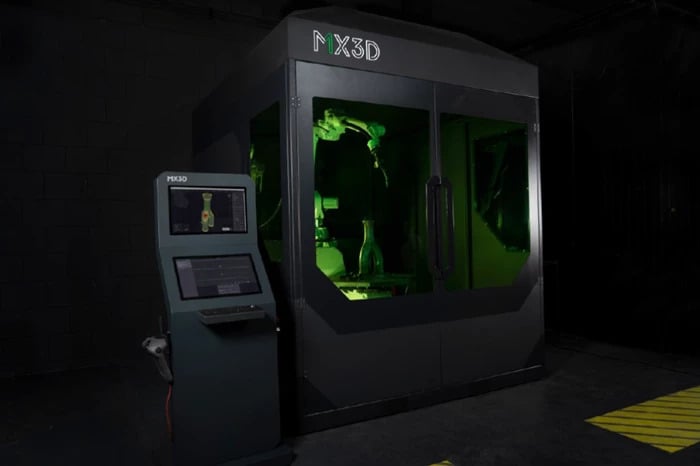
Phillips Corporation is highlighting the growing potential of large-format metal additive manufacturing with the presentation of the MX3D M1 Metal AM system at IMTS 2026. Designed for the production, repair, and restoration of large metal components, the M1 offers manufacturers a new approach to fabricating complex parts while reducing material waste, improving production flexibility, and accelerating project timelines.
As industries increasingly seek more agile and cost-effective manufacturing methods, additive manufacturing is emerging as a powerful complement to traditional machining and casting processes. While metal 3D printing has already gained traction for producing smaller, high-value components, large-format additive manufacturing is opening new opportunities for tooling manufacturers, mold builders, heavy equipment producers, and industrial manufacturers that require large metal structures, custom parts, and low-volume production runs.
The MX3D M1 system has been developed specifically to address these challenges by enabling the production of large-scale metal components using advanced additive manufacturing technology. Rather than removing material from a solid workpiece as in conventional machining, the system builds components layer by layer, depositing material only where it is needed. This approach can significantly reduce raw material consumption and improve overall manufacturing efficiency.
One of the most important advantages of large-format metal additive manufacturing is its ability to produce components closer to their final geometry. Traditional manufacturing methods often require substantial machining allowances, resulting in large amounts of material being removed during production. By creating near-net-shape parts, the M1 minimizes excessive material waste while reducing machining time and associated production costs.
For mold makers and tooling manufacturers, the technology offers particularly compelling benefits. Large tooling structures, molds, dies, and casting components often involve lengthy lead times and high production costs when manufactured through conventional methods. The ability to additively manufacture or repair these components provides manufacturers with greater flexibility while helping reduce downtime and accelerate project completion.
The M1 system also supports repair and remanufacturing applications, an area that is gaining increasing attention across industrial sectors. Instead of replacing entire components when wear, damage, or defects occur, manufacturers can rebuild specific areas through additive deposition processes. This capability can extend component life, reduce replacement costs, and improve equipment availability, particularly for large and expensive industrial assets.
In industries where downtime carries significant financial consequences, the ability to restore worn components quickly can provide substantial operational advantages. Large molds, tooling systems, industrial machinery components, and production equipment can often be repaired and returned to service faster than replacement parts can be sourced or manufactured. As a result, additive manufacturing is becoming an important tool for maintenance, repair, and overhaul (MRO) operations.
Another area where the M1 offers value is casting replacement. Traditional casting processes can be time-consuming and costly, especially when producing large, low-volume components. Tooling costs, pattern development, and long lead times often make casting economically challenging for specialized applications. Large-format metal additive manufacturing provides an alternative production method that eliminates many of these constraints while enabling greater design flexibility.
Manufacturers can use the technology to produce customized components, prototypes, replacement parts, and one-off structures without the need for dedicated tooling. This flexibility is particularly beneficial for industries that require highly specialized components or operate with limited production volumes. By reducing dependence on conventional casting methods, companies can respond more quickly to customer demands and changing market requirements.
The adoption of additive manufacturing also supports broader efforts to improve sustainability within manufacturing operations. Because material is deposited only where needed, additive processes typically generate less waste compared to subtractive manufacturing methods. Reduced material consumption, lower scrap rates, and the ability to repair rather than replace components contribute to more efficient resource utilization and support environmental objectives.
Phillips Corporation emphasizes that additive manufacturing should not be viewed as a replacement for traditional manufacturing technologies but rather as a complementary capability that can work alongside machining, fabrication, and casting processes. By combining additive and subtractive manufacturing techniques, companies can optimize production strategies, improve efficiency, and expand their overall manufacturing capabilities.
This hybrid approach is becoming increasingly important as manufacturers seek to balance productivity, quality, cost, and flexibility. Components can be additively manufactured near net shape and then finished using precision machining processes to achieve final tolerances and surface requirements. This combination enables manufacturers to leverage the strengths of both technologies while minimizing their respective limitations.
At IMTS 2026, attendees will have the opportunity to see the MX3D M1 Metal AM system in operation through live demonstrations and technical presentations. These demonstrations will showcase how large-format metal additive manufacturing can support tooling production, component repair, remanufacturing, and industrial fabrication applications.
As manufacturers continue exploring new ways to improve efficiency and adapt to increasingly complex production requirements, technologies such as the MX3D M1 are helping redefine what is possible in metal manufacturing. By enabling the production and restoration of large components with greater flexibility, reduced waste, and shorter lead times, large-format metal additive manufacturing is emerging as a valuable tool for the future of industrial production.
Through its collaboration with MX3D and its focus on advanced manufacturing technologies, Phillips Corporation is helping manufacturers evaluate how additive manufacturing can be integrated into existing workflows to improve productivity, enhance responsiveness, and unlock new opportunities for innovation across a wide range of industries.