🎧Measurement cycles carved in stone with precision
0:00 / 0:00
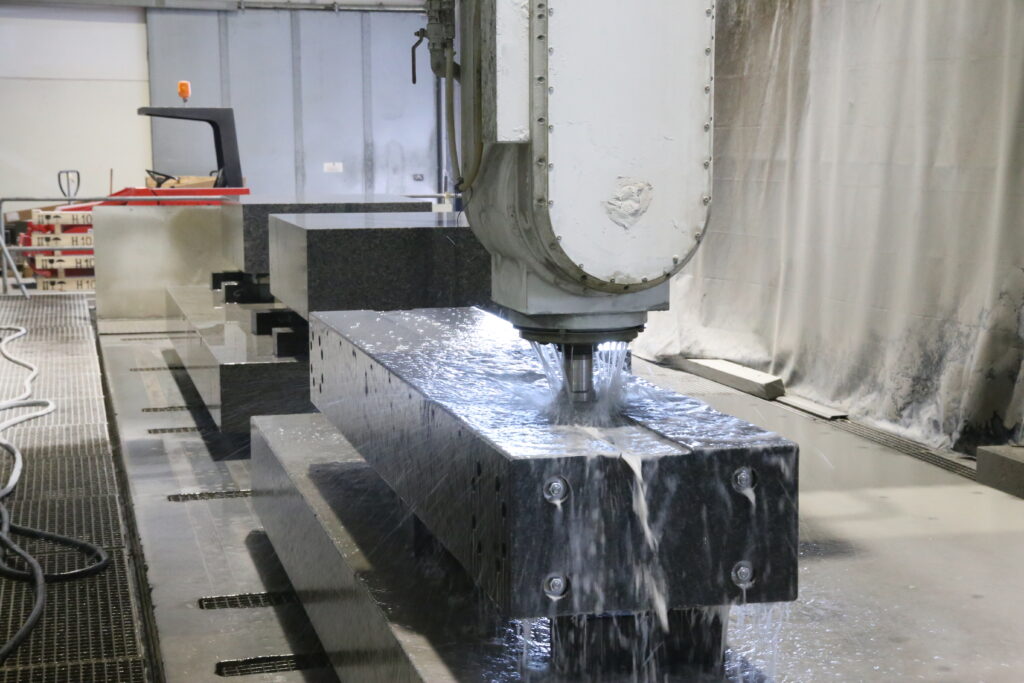
Reitz Natursteintechnik KG plans, designs and manufactures highly precise machine components from granite. To ensure efficient processing, Vericut is employed, offering the advantages of reliable production and a reduced workload.
The origins of Reitz date back to 1946, when Herrmann Reitz began extracting raw stone from his own quarry in Asslar. With the arrival of his son Friedel, gravestones were produced from 1958 until the introduction of the first granite surface plates that changed the business model, leading to the establishment of E. Reitz Natursteintechnik e.K. in 1986. Today, Christopher Reitz, the fourth generation and current Managing Director says: “Today’s machine components combine the million-year-old material stone with cutting-edge technology. For 35 years, we’ve been manufacturing components from granite and offering system assembly and custom solutions and complete systems.”
The company currently employs approximately 140 people with clients in the semiconductor, optics, general mechanical engineering, metrology, printing, and medical sectors.
Competitive Edge with Granite
“We’ve been experts in processing natural hard stone for over 60 years—a tradition we’re proud of,” says Reitz.
In mechanical engineering, particularly in machine tool construction, achieving optimum precision and performance is crucial. The machine bed is pivotal.
“Due to its properties, granite offers clear advantages that neither steel nor mineral casting can match: stability, temperature resistance, vibration damping, and accuracy make granite the ideal material for machines,” explains Reitz.
It’s no surprise, therefore, that granite is commonly utilised in measuring and test stands, as well as coordinate measuring machines, for components such as surface plates, tables, and machine frames.
In-House Built Gantry Milling Machines
“Our granite comes mostly from South Africa, Spain, France, and Austria. It’s either delivered in pre-cut slabs or as raw blocks we cut in-house. The workpieces vary in size, from 250 by 250mm up to 13m. The largest we ever made was 13 by 1.5 by 1m and weighed about 65 tons,” adds Reitz.
To accurately process such blocks, Reitz relies predominantly on machines developed and constructed in-house: four gantry-type milling machines and two 5-axis gantry machines, all controlled by Siemens 840D. To ensure safe, fast, and precise granite machining, the company uses Vericut simulation software.
“Granite is a natural product, so the surface is never flat. To prevent tool collisions during processing, we developed a process with Vericut that virtually eliminates this risk,” explains Reitz.
Stephan Meurisse, Marketing Manager at Vericut, Deutschland, adds: “Downtime, damaged tools, costly collisions, unusable parts, long setup times, wasted materials—all of that costs time and money. Vericut helps our customers avoid these time and cost traps.”
“Vericut eliminates the need for manual setup, saves valuable operator time, and protects our machines,” says René Maschlanka, responsible for sales and project management at Reitz.
Intelligent Process Flow
Granite blocks up to 13m long are typically delivered with +3 to 5mm oversize. They are then machined to a flatness of 20 to 5µm. Since granite is very hard (Mohs hardness 6–8), only 0.1mm of material can be removed per cut.
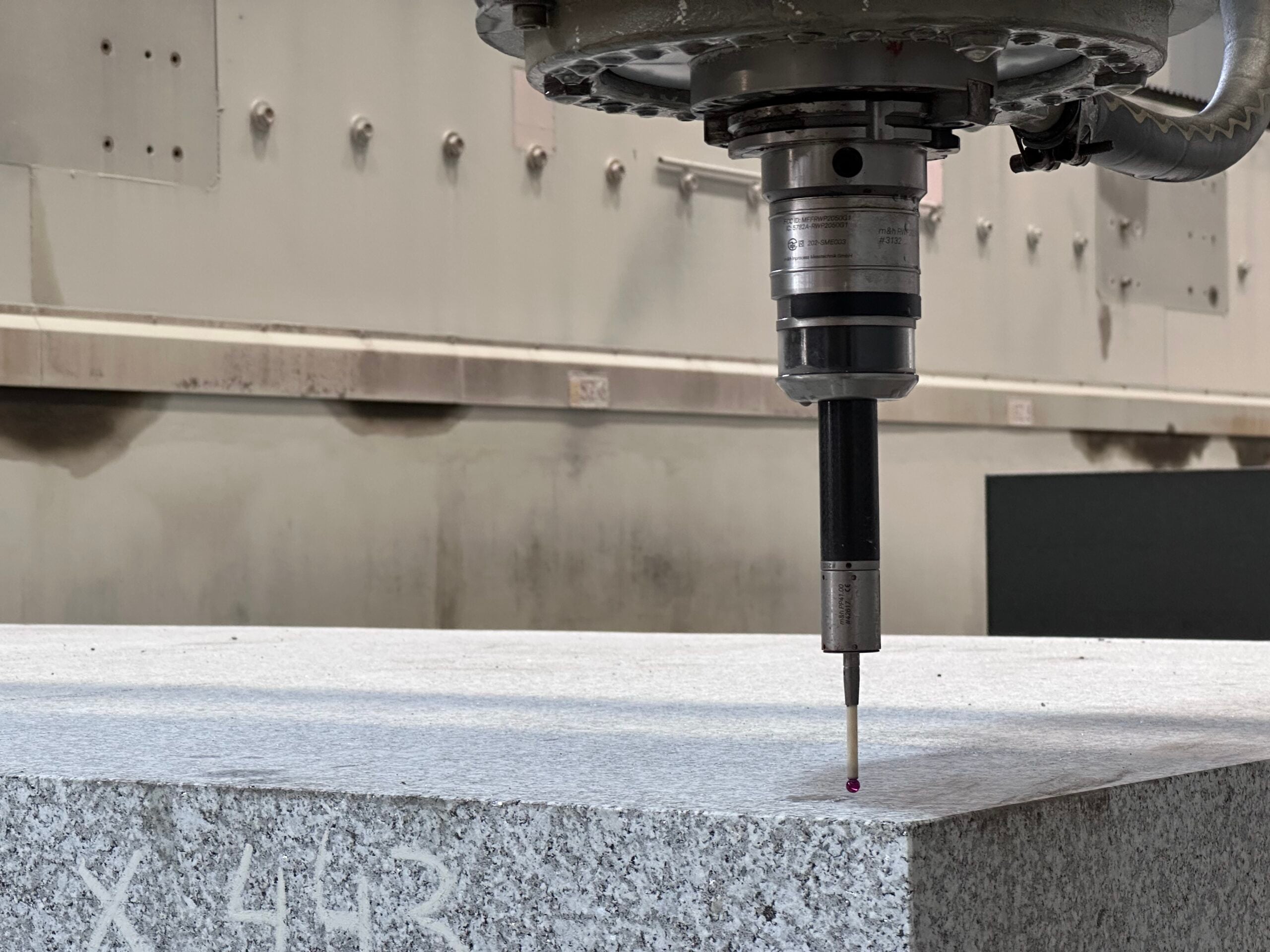
After a visual inspection, the operator selects a measurement point pattern, generating two automatic measurement programmes in the CAM system. The first determines the block’s position, and the second maps its surface—both via probing cycles,” says Maschlanka.
Each probing cycle uses valuable machine time, so it is performed as infrequently as possible, yet as frequently as necessary. The resulting programs are converted into NC code and simulated in Vericut. Once verified, the programs are run on the machine.
“The returned measurement points describe the actual surface condition, and from that data, a machining programme for a precise cuboid is automatically derived, then simulated in Vericut before execution,” explains Meurisse.
The completed cuboid is then drilled for guide rails, drives, spindles, sensors, and attachments. Once the stainless steel thread inserts are glued in, the component is sent to the climate-controlled precision lab for final machining. “Naturally, these final programs are also validated with Vericut,” Maschlanka emphasises.
“We use a special CAM system for granite processing. We built the interface to Vericut ourselves. It lets us precisely capture the position and shape of the workpiece and simulate automated steps without manual setup,” says Maschlanka.
The simulation assists in detecting unnecessary movements, clamping errors, and incorrect tool usage before they occur. Some machining processes at Reitz can take over 40 hours. Previously, the operator had to stand by the entire time. Now, they simulate on a PC, press start, and only check in occasionally.
“Now our programmers and operators are far more relaxed—they know their programs will run safely, with no crashes. The integrated Vericut Reviewer shows us when that approach makes sense,” says Reitz.
Vericut Reviewer allows users to interact with the simulation file on any Windows PC or tablet. It helps build trust in new processes. “Operators, shop floor staff, or engineers can review simulations and confirm the project is correct before running it on the machine. Our staff love the Reviewer. It shows the full machining sequence, highlights critical steps, and helps with prep, like planning supports, tools, and clamping,” says Meurisse.
Thanks to Vericut, tool breakage and collisions due to programming errors are a thing of the past at Reitz Natursteintechnik KG. “Vericut is a huge help and a great tool. It’s easy to use, gives programmers confidence, avoids costly collisions, and keeps our operators at ease,” summarises Christopher Reitz.