
TRUMPF Introduces AI-Powered Automated Parts Sorting System for Laser Cutting Operations!
TRUMPF has unveiled its latest automated parts sorting technology for the North American market, introducing the SortMaster Station and SortMaster Vision as an integrated solution designed to automate one of the most labour-intensive stages of laser cutting operations. Demonstrated at the company’s Smart Factory facility in Hoffman Estates, Illinois, the new system combines intelligent material handling, machine vision and artificial intelligence to automate the separation, sorting and stacking of laser-cut parts. The technology is aimed at helping sheet metal fabricators improve productivity, reduce manual labour and accelerate production flow by minimizing work-in-process between laser cutting and downstream manufacturing operations.
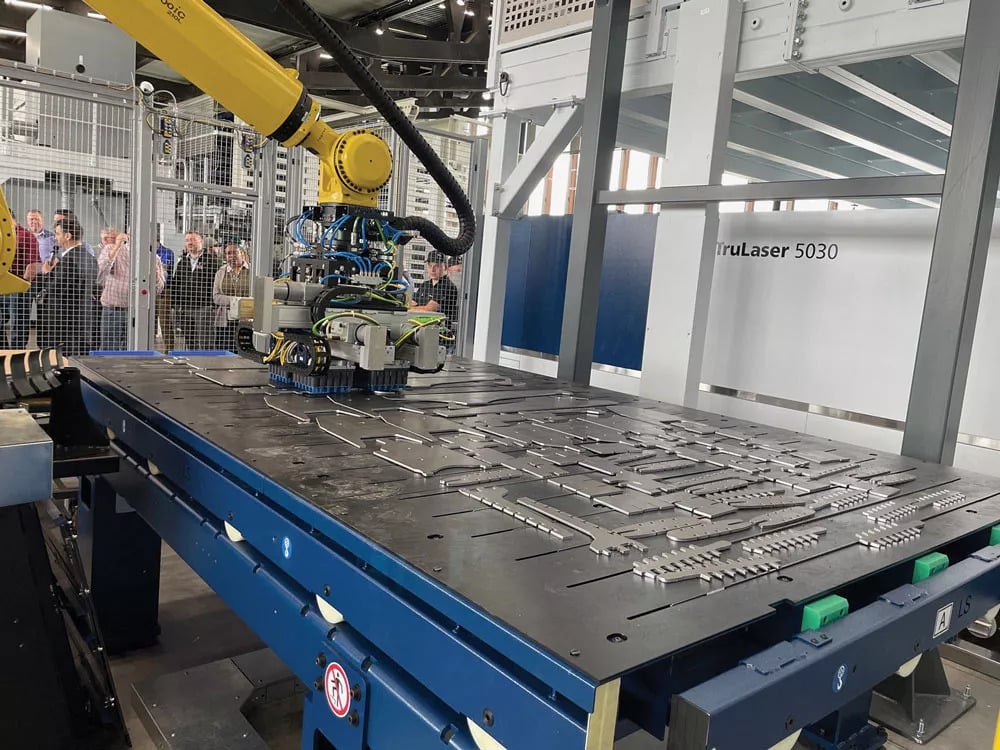
The automated solution was showcased in combination with a TruLaser 5030 12-kW laser cutting machine during a dedicated event for manufacturers and industry media. According to TRUMPF, while modern laser cutting systems have become significantly faster and more powerful, many fabrication shops continue to face bottlenecks when removing finished components from the metal skeleton. Manual part separation and sorting often consume considerable time and labour, preventing manufacturers from fully realizing the productivity gains delivered by high-speed laser cutting technology.
Addressing attendees during the demonstration, Kartik Iyer, Director of Smart Factory at TRUMPF, explained that studies have shown manufactured components spend a substantial portion of their production lifecycle in non-value-added activities rather than actual machining processes. He noted that workpieces often spend far more time waiting to be moved, sorted or processed than they do inside laser cutting machines, press brakes or welding stations. By automating these indirect processes, manufacturers can reduce production delays, improve workflow efficiency and deliver finished parts to customers more quickly.
The first stage of the new solution is the SortMaster Station, which automatically separates laser-cut components from the remaining sheet skeleton. After the laser cutting operation is completed, TRUMPF’s LiftMaster Compact automation system transfers the processed sheet directly to the SortMaster Station. Inside the unit, specially designed clamps grip the sheet while controlled vibration breaks the small micro-joints that temporarily hold components within the skeleton. During this process, the chamber ceiling moves close to the workpiece to prevent parts from bouncing or shifting uncontrollably. The system continuously monitors the separation process and automatically determines whether additional vibration is required to completely release all components. Once separation is complete, the remaining skeleton is automatically removed from the system while the finished parts proceed to the next stage without manual intervention.
The second stage is the SortMaster Vision, an AI-powered robotic sorting system developed in collaboration with Intrinsic, a robotics software and artificial intelligence company affiliated with Google. After receiving the separated components, cameras scan both the workpieces and the surrounding palletizing area to identify part positions and available storage locations. Using advanced vision technology, the system evaluates component orientation, detects overlapping parts and determines the optimal picking sequence before initiating robotic handling operations.
A key innovation within the SortMaster Vision is its use of artificial intelligence to generate robot motion plans automatically. Instead of relying on manually programmed robot paths, the system combines AI algorithms with CAD data to simulate the most efficient gripping points, movement paths and placement strategies for each individual component. This approach enables the robot to autonomously determine how to grasp, lift, transport and stack parts into bins or onto pallets without requiring extensive programming. TRUMPF describes this capability as an important step toward “physical AI,” where intelligent robotic systems can understand their environment, make decisions and execute complex handling tasks with minimal human intervention, particularly in high-mix manufacturing environments.
The automated sorting system is capable of handling laser-cut parts up to 25 mm thick, with demonstrated processing of both 16 mm and 3 mm components during the live presentation. It accommodates parts ranging from 50 mm × 50 mm to 1.2 metres × 1 metre and can handle individual components weighing up to 120 kilograms. To support reliable separation, sheet nests require a minimum clearance of 14 mm along the short edges for the internal clamping mechanism. The system also provides flexibility in production planning, allowing manufacturers to organize sorting according to production priorities, assembly kits or customer-specific requirements rather than requiring jobs to follow a fixed processing sequence.
By integrating intelligent material separation, AI-driven robotic sorting and automated palletizing into a unified workflow, TRUMPF’s SortMaster Station and SortMaster Vision provide manufacturers with a comprehensive solution for eliminating one of the final manual bottlenecks in laser cutting operations. Scheduled to become available across North America later in 2026, the technology is expected to help fabricators improve throughput, reduce labour dependency and enhance manufacturing efficiency as they continue their transition toward fully automated and digitally connected production environments.