
Concepts NREC Enhances Agile Engineering Design System with Advanced Turbomachinery Design and CAM Capabilities!
Concepts NREC has released version 2026.1 of its Agile Engineering Design System (AEDS), introducing a range of new capabilities designed to streamline design, analysis and manufacturing workflows for turbomachinery engineers. The latest software update strengthens computational fluid dynamics (CFD) analysis, enhances machining flexibility for complex blade geometries and improves integration between engineering tools, enabling manufacturers to shorten product development cycles while improving design accuracy and manufacturing efficiency. By bringing multiple engineering disciplines into a single software environment, AEDS helps engineering teams accelerate the transition from concept development to production-ready components.
The Agile Engineering Design System is an integrated Computer-Aided Engineering (CAE) and Computer-Aided Manufacturing (CAM) platform developed specifically for turbomachinery applications. It combines aerodynamic design, flow analysis, optimization and manufacturing within one unified environment, eliminating many of the inefficiencies associated with transferring data between separate engineering software packages. This integrated approach enables engineers to reduce development time, improve design fidelity and achieve greater collaboration across product development teams while maintaining a seamless digital workflow throughout the engineering process.
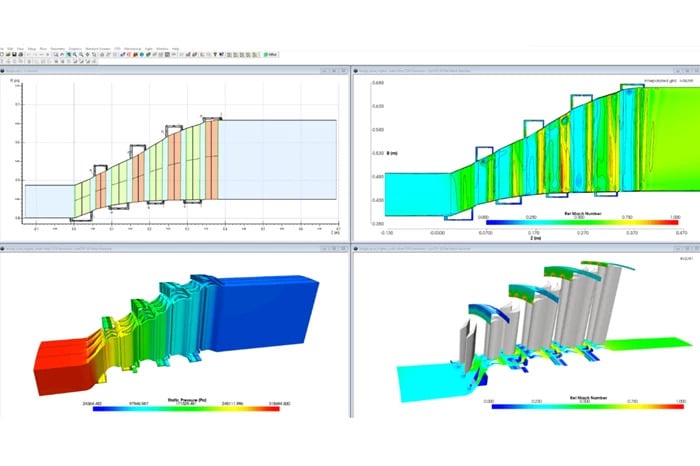
One of the key enhancements in version 2026.1 is the expansion of secondary leakage path analysis capabilities, building upon features introduced in the previous 2025.2 release. The latest version provides deeper CFD functionality for both radial and axial turbomachinery by supporting secondary passage analysis using standard, stepped and custom labyrinth seal configurations. Engineers can perform these simulations using Cadence Fidelity Fine Turbo and Concepts NREC’s proprietary pbCFD software, enabling more accurate prediction of leakage flows and improved aerodynamic performance. Enhancements to secondary flow path geometry handling within AxCent also provide greater design flexibility while improving CFD solution stability and success rates for complex engineering models.
The new release also introduces stronger integration between different software modules, significantly reducing setup time for engineering analysis and optimization projects. An automated connection between AxCent and CTAADS now enables direct transfer of blade geometry and CFD results into cooled turbine analysis projects, eliminating manual data transfer and reducing the risk of errors. This seamless workflow improves engineering efficiency while allowing designers to focus more on product development rather than software administration.
Further workflow improvements have been made to TurboOpt II, Concepts NREC’s turbomachinery optimization platform, through enhanced integration with Ansys OptiSLang. The updated interface enables automatic exchange of design inputs and optimization results between the two applications, simplifying project setup and enabling faster execution of complex optimization studies. These enhancements allow engineering teams to evaluate multiple design alternatives more efficiently while accelerating product performance optimization.
Version 2026.1 also delivers significant improvements to MaxPac, Concepts NREC’s CAM solution for turbomachinery manufacturing. The latest release expands machining flexibility for complex blade geometries by providing engineers with additional options for roughing, finishing and multi-orientation machining operations. New spiral roughing toolpaths have been introduced for single blades used in shrouded or tailstock-supported components where conventional blade-tip entry is not feasible. The software also adds undercutting support for 3+2 roughing operations using lollipop, disc and barrel cutting tools, enabling greater material removal during each machining orientation while minimizing machine repositioning and improving overall machining efficiency.
Additional improvements have been made to blade finishing operations, allowing toolpaths to extend through the blade fillet and onto the hub. This enhancement eliminates cusps and mismatches at the leading edge, resulting in superior surface quality and improved dimensional accuracy for finished turbomachinery components. Complementing these manufacturing enhancements is an updated machining setup interface that consolidates process documentation customization into a single location. Users can now easily configure setup images, reporting formats, column layouts and export options in HTML or TXT formats, ensuring more consistent documentation across manufacturing projects.
By combining advanced CFD analysis, improved software integration, expanded machining capabilities and enhanced process documentation tools, Concepts NREC’s Agile Engineering Design System version 2026.1 provides turbomachinery manufacturers with a comprehensive digital engineering platform that improves productivity, reduces development time and supports the efficient production of increasingly complex high-performance components.