
Fryer’s MB-R Toolroom Bed Mill Combines Conversational CNC Control with Manual Flexibility for Efficient Shop Floor Operations!
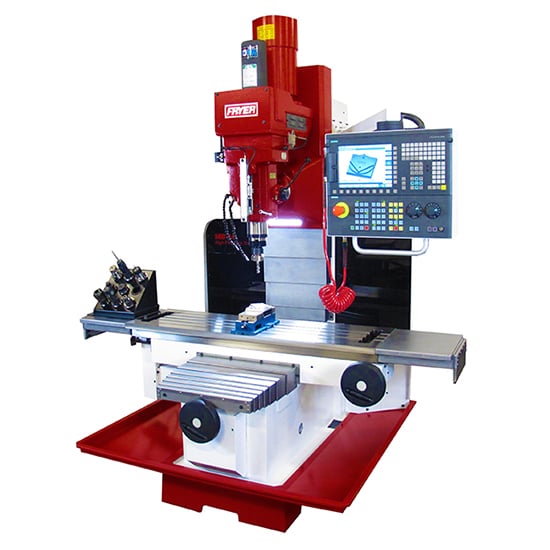
Fryer Machine Systems has introduced the MB-R Toolroom Bed Mill, a versatile machining solution designed to bridge the gap between manual machining and advanced CNC operations. Built in the United States, the MB-R is specifically engineered for job shops, toolrooms, maintenance departments, prototype development centers, and low-volume production environments where flexibility, ease of use, and precision are essential.
In today’s manufacturing landscape, many workshops require machines that can efficiently handle one-off components, prototype work, repair jobs, and short production runs without the complexity often associated with traditional CNC programming. The MB-R addresses these needs by combining conversational control technology with manual operating capabilities, allowing users of varying skill levels to quickly produce precision parts while minimizing setup time and programming effort.
One of the defining features of the MB-R is its user-friendly conversational control system. Unlike conventional CNC machines that often require extensive programming knowledge, the MB-R utilizes simple menu-driven programming and fast setup keys that make machine operation intuitive and accessible. Operators can quickly create machining programs through guided conversational prompts, significantly reducing the learning curve and enabling faster job turnaround.
This ease of operation makes the machine particularly attractive for toolrooms and job shops where flexibility and responsiveness are critical. Whether producing a single prototype component or managing small batch production runs, users can move from setup to machining with minimal delay, improving overall productivity and shop efficiency.
A unique aspect of the MB-R is its ability to combine manual machining functionality with CNC-assisted operations. The machine is equipped with manual handwheels for the table, saddle, and spindle head, allowing operators to perform traditional manual machining tasks when required. According to Fryer, no prior CNC experience is necessary to operate these manual controls, making the machine accessible to machinists who are more familiar with conventional milling equipment.
These manual handles are supported by a full digital readout (DRO) system that provides precise positional feedback in real time. The combination of manual control and digital accuracy allows operators to maintain complete control over machining operations while benefiting from modern precision measurement capabilities.
The MB-R also incorporates innovative “Do One” machining cycles designed to simplify common manufacturing tasks. These automated cycles enable operators to perform milling, pocketing, drilling, and tapping operations one step at a time without requiring complex CNC programming. This feature is especially beneficial for prototype work, repair applications, and custom component production where speed and simplicity are often more important than full automation.
The flexibility to blend manual machining with semi-automated operations further enhances the machine’s versatility. Operators can choose the most efficient approach for each job, combining manual positioning with automated machining cycles to optimize productivity for one-piece production and short-run manufacturing. This hybrid approach provides the benefits of CNC technology without sacrificing the flexibility that many toolroom applications demand.
From a structural perspective, the MB-R is engineered for stability and precision. The machine features a robust one-piece cast-iron base that provides exceptional rigidity and vibration dampening. This solid construction helps maintain machining accuracy and contributes to long-term durability, even under demanding shop conditions.
High-precision ball screws and premium bearing systems further enhance the machine’s performance by ensuring smooth motion control and accurate positioning. The result is a machine capable of achieving positioning accuracy of up to 0.0002 inches, making it suitable for applications requiring tight tolerances and repeatable precision.
The rigid spindle head design is another key contributor to the machine’s performance. A stable spindle structure minimizes deflection during cutting operations, improving surface finish quality and dimensional accuracy while supporting a broad range of machining applications. Whether working with steel, aluminum, plastics, or specialty materials, the machine is designed to deliver consistent results across various manufacturing tasks.
For shops seeking greater automation and productivity, the MB-R can also be equipped with an optional automatic tool changer. This capability allows operators to perform multiple machining operations without manual tool changes, reducing cycle times and increasing operational efficiency for more complex jobs.
Despite its robust capabilities, the MB-R maintains a compact footprint, making it well-suited for facilities where floor space is limited. Its space-efficient design enables manufacturers to add advanced machining capability without requiring significant facility modifications or sacrificing valuable production area.
The machine’s combination of conversational CNC control, manual machining flexibility, precision engineering, and compact design makes it a practical solution for a wide variety of manufacturing environments. Job shops can use it for rapid turnaround projects, toolrooms can leverage its ease of use for maintenance and repair work, and educational institutions can utilize it as a training platform that helps students transition from manual machining to CNC operations.
As manufacturers continue to seek equipment that delivers productivity without complexity, Fryer’s MB-R Toolroom Bed Mill offers a compelling solution. By combining traditional machining accessibility with modern CNC functionality, the machine provides an ideal platform for precision machining, prototyping, repair work, and short-run production, helping shops improve efficiency while maintaining the flexibility needed in today’s competitive manufacturing environment.